
Buying shipping containers for sale should be straightforward: pick a size, choose a condition, get it delivered, done. But many buyers in the U.S. only find out later that the “price” they saw online was just the starting point.
Hidden fees do not always come from bad intent, sometimes they come from vague quoting, unclear delivery assumptions, or condition grades that are not defined upfront. The good news is you can prevent most surprises by knowing what to ask and insisting on an “all-in delivered” quote.
What “hidden fees” usually mean when buying shipping containers
In the container industry, a “hidden fee” is typically any cost that was not clearly disclosed before you committed, such as delivery add-ons, offload charges, re-delivery fees, taxes, or repairs needed because the condition grade was overstated.
To make comparisons easier, you want every seller you talk to to quote the same thing:
- Container price by grade (new/one-trip vs used, cargo-worthy, wind and watertight)
- Delivery cost to your exact address
- Offload method and any special equipment required
- Any taxes or payment fees
- Any add-ons you requested (lock box, vents, paint, shelving)
If you only get a “container price” without the details above, you are not looking at the real cost.
The most common hidden fees (and how to avoid each one)
1) Delivery cost that is not really included
Many listings show an attractive container price, then you learn shipping is extra, or the quote was based on delivery to a different ZIP code.
How to avoid it: Ask for a written quote that states “delivered to (your address)” and includes the delivery method.
Location matters a lot. Delivery pricing can differ widely between major metros and more rural areas, even within the same state. A delivery to Houston, Dallas, Atlanta, Phoenix, Miami, Orlando, or Los Angeles may price differently than delivery 60 to 100 miles outside the city.
2) Offload or equipment fees (tilt-bed vs crane)
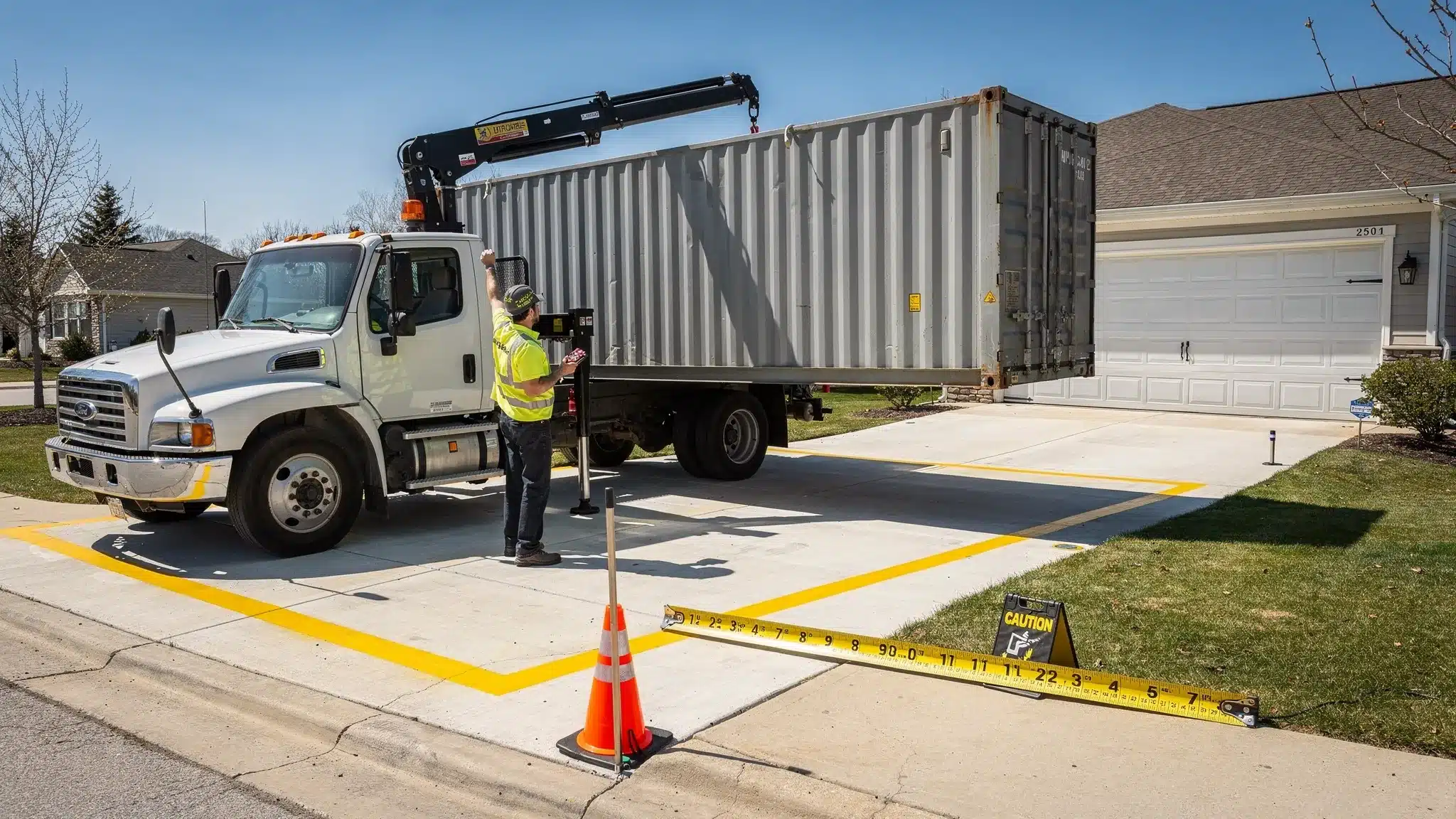
A container still needs to come off the truck. If you assumed the driver would set it down and the seller assumed “drop at site with customer-provided equipment,” you can get hit with a crane, forklift, or third-party offload charge.
Common offload scenarios include:
- Tilt-bed delivery: The truck tilts and slides the container off onto the ground (often the simplest for 20ft units when access is good).
- Flatbed delivery: May require a forklift or crane on site to unload, depending on how the carrier is dispatched.
How to avoid it: Confirm in writing:
- What truck type is planned
- Whether offload is included
- Whether you must provide equipment
3) “Accessorial” charges for tight sites (and re-delivery fees)
Even with a good quote, delivery can get expensive if the driver arrives and cannot safely access your drop location. That can trigger:
- Re-delivery charges (you pay for a second attempt)
- Jobsite access fees (tight turns, soft ground, limited clearance)
- Wait time/detention if the truck is stuck waiting for you to clear space
How to avoid it: Before ordering, do a quick access check:
- Measure gate width and turning space
- Check overhead clearance (trees, power lines, building overhangs)
- Confirm the surface is stable (gravel, asphalt, compacted base is ideal)
If you are unsure, ask the seller what clearance the carrier typically needs for 20ft and 40ft deliveries and send photos of your site.
4) Condition surprises that turn into repair costs
One of the biggest “hidden fees” is not a line item at all. It is paying for fixes because the container’s condition was not accurately represented.
For example:
- A container sold as “wind and watertight” that needs door gasket work
- A “cargo-worthy” container that has floor damage that affects storage use
- Rust that is cosmetic for storage, but a problem for a conversion project
How to avoid it: Make sure the condition grade is defined and documented. If you need the container for actual shipping/export, confirm what documentation is included (for example, many buyers look for a valid CSC safety approval plate depending on the use case. The International Convention for Safe Containers (CSC) is the international framework behind these requirements).
Also ask for current photos of the actual unit (or the specific inventory batch) and what inspections are performed before dispatch.
5) Added costs for modifications and accessories
It is common to add items like lock boxes, vents, shelving, lighting, or roll-up doors for storage and jobsite use. The hidden-fee problem happens when buyers assume something is included because it appears in a photo or because a listing uses general language like “ready to use.”
How to avoid it: Treat every add-on as a separate line item and confirm it on the invoice.
6) Taxes, card processing fees, and “admin” charges
Some sellers add fees at checkout, especially on card payments. Others quote a price but do not mention taxes until late in the process.
How to avoid it: Ask: “Is this the total out-the-door delivered price, including any taxes and payment fees?” If you are tax-exempt, ask what documentation they require.
7) Permitting, zoning, and site-prep costs (not charged by the seller, but still real)
These are not always seller fees, but they are common budget surprises:
- City permits or zoning rules for long-term placement
- HOA restrictions
- Foundation or base material (gravel pad, blocks, piers)
How to avoid it: Call your city or county before delivery if the container will be placed long-term or used in a residential setting. If this is for a construction site, confirm your GC’s site plan includes a container location with proper access.
Hidden fees checklist (featured-snippet friendly)
Use this table to quickly pressure-test any quote for shipping containers for sale.
| Cost item to confirm | What to ask the seller | Why it becomes a “hidden fee” |
|---|---|---|
| Delivery to your address | “Is delivery included to my exact address/ZIP?” | Some prices are depot-only or estimated to a different ZIP |
| Offload method | “Tilt-bed or flatbed, and is offload included?” | Flatbed deliveries can require a forklift/crane |
| Site access and re-delivery | “What happens if the truck cannot access my drop site?” | Re-delivery and wait time can be expensive |
| Taxes and payment fees | “Any taxes, processing fees, or admin charges?” | Added at checkout or on the invoice |
| Condition grade definition | “Is it cargo-worthy or wind and watertight, and what does that mean in writing?” | Grade mismatch leads to repair or replacement costs |
| Photos/inspection proof | “Can you share recent photos and inspection notes?” | Reduces risk of unexpected damage |
| Add-ons and modifications | “What is included vs optional (lock box, vents, paint)?” | Assumptions lead to surprise line items |
How to ask for an all-in delivered quote (and compare sellers fairly)
If you only do one thing to avoid hidden fees, do this: request an all-in delivered quote that lists line items clearly.
What to send when requesting a quote
The more specific you are, the less room there is for surprise charges later.
- Delivery address (not just city)
- Container size needed (10ft, 20ft, 40ft, or 40ft high cube)
- Intended use (storage, jobsite, export/shipping, conversion)
- Preferred condition (new/one-trip vs used, cargo-worthy, wind and watertight)
- Any access constraints (narrow driveway, soft ground, steep grade)
- Desired door orientation at drop-off (important for usability)
What a good quote should include
At minimum, a professional quote should state:
- Container size and type (example: 20ft standard, 40ft standard, 40ft high cube)
- Condition grade and a plain-English description of what that grade means
- Container price
- Delivery price to your exact address
- Offload method assumptions
- Delivery timeline estimate
- Payment terms
If any of those are missing, you cannot accurately compare offers.
Red flags that often signal misleading pricing
You do not need to be a container expert to spot risk. Watch for these common red flags:
- “Delivery available” but no delivered price. That usually means you are about to see a big add-on.
- Unclear condition language. Words like “good condition” without an actual grade (one-trip/new, wind and watertight, cargo-worthy) are not enough.
- Pressure to pay fast without documentation. Legit sellers can provide invoices, business details, and clear terms.
- Prices far below the market with no explanation. Extremely cheap containers are often “as-is” units with issues that matter for storage or conversions.
For more guidance on shopping safely, see our internal resource on vetting sellers when searching shipping containers near me: Shipping Containers Near Me: How to Vet Sellers Fast.
What transparent pricing looks like with Global Containers Line
Global Containers Line is a U.S.-based supplier of new and used containers, focused on clear condition standards and fast nationwide delivery across the United States. All units are inspected before dispatch and sold as cargo-worthy and wind and watertight options (depending on what you select), so you can buy for storage, construction sites, commercial use, or residential projects with fewer surprises.
If you are comparing sizes, start here:
- Browse 20ft shipping containers for compact storage, jobsite tools, and tight drop locations.
- Browse 40ft shipping containers for larger storage, inventory overflow, farm equipment, or multi-room builds.
If you are not sure what you need, our ultimate shipping container buying guide walks through sizing, condition, and delivery planning.
Quick pre-purchase checklist to avoid hidden fees
Before you place an order for shipping containers for sale, take five minutes to confirm the basics:
- You have the delivered price in writing (container + delivery + offload assumptions).
- You know the container grade and what it means for your use case.
- Your site can accept delivery (clearance, turning space, stable surface).
- You have a plan for placement (blocks, gravel pad, or prepared base).
- You know what is included (lock box, vents, paint, modifications) and what is optional.
Browse inventory or request a delivered quote
If you want a container without pricing surprises, browse available units or request a delivered quote from Global Containers Line. We offer fast nationwide delivery across the USA, transparent pricing, and inspected containers ready for storage, construction, and project use.
Explore inventory now: 20ft shipping containers and 40ft shipping containers, or visit Global Containers Line to request a quote for your city or ZIP code.