
Most shipping container office projects don’t fail because of the container, they fail because power, HVAC, and permits were treated as “later problems.” If you plan those three early, a container office can be a fast, secure way to add workspace on a jobsite, farm, yard, or commercial property in cities like Houston, Dallas, Atlanta, Phoenix, Miami, and beyond.
This guide breaks down the basics U.S. buyers need to know before ordering a container and starting a build: electrical planning, heating and cooling, and the permit questions that typically come up.
What is a shipping container office (and what it is not)
A shipping container office is typically a 20ft or 40ft steel ISO container that’s converted into usable workspace by adding insulation, electrical, lighting, HVAC, and interior finishes.
It is not automatically “code-compliant” just because it’s made of steel, and it’s not automatically plug-and-play unless it’s specifically built and equipped as an office.
Quick definition for planning: A container can be structurally sound and weather-resistant, but it still needs proper electrical design, ventilation, and local approval to be used as an occupied space.
Step 1: Choose the right container size and condition for an office build
Most office conversions start with a 20ft or 40ft unit.
- 20ft container office: Better when space is tight, you need a small admin office, guard shack-style office, or a single-room workspace.
- 40ft container office: Better for multi-desk layouts, conference space, break area, or when you want to separate work zones.
You can browse common office-friendly sizes here:
- 20ft shipping containers
- 40ft shipping containers
Condition basics that matter for office conversions
For an office build, you typically want a container that is:
- Wind and watertight: So you are not fighting leaks while insulating and finishing.
- Structurally solid with working doors: Door seal integrity and frame alignment matter.
- Clean enough for interior work: You can paint and refinish, but you do not want major contamination issues.
Global Containers Line supplies new and used containers for conversion and storage, each unit is thoroughly inspected before dispatch, and we offer fast nationwide delivery across the United States.
Step 2: Shipping container office power basics (electrical planning)
Electrical is one of the first items you should sketch out, even before you decide exact wall finishes. Why? Because your electrical plan affects insulation strategy, HVAC selection, and permit scope.
Common power needs in a container office
Most shipping container offices need power for:
- Lighting (interior and exterior)
- HVAC (often the largest load)
- Outlets for computers, printers, chargers, tools
- Small appliances (microwave, mini fridge, coffee maker)
- Network equipment (router, modem)
Featured snippet takeaway: HVAC usually drives the electrical design. Pick HVAC first, then confirm your service size.
120V vs 240V in real-world office builds
- 120V circuits commonly run outlets, lighting, and small devices.
- 240V circuits are commonly used for many mini-split systems, larger HVAC equipment, and some specialty loads.
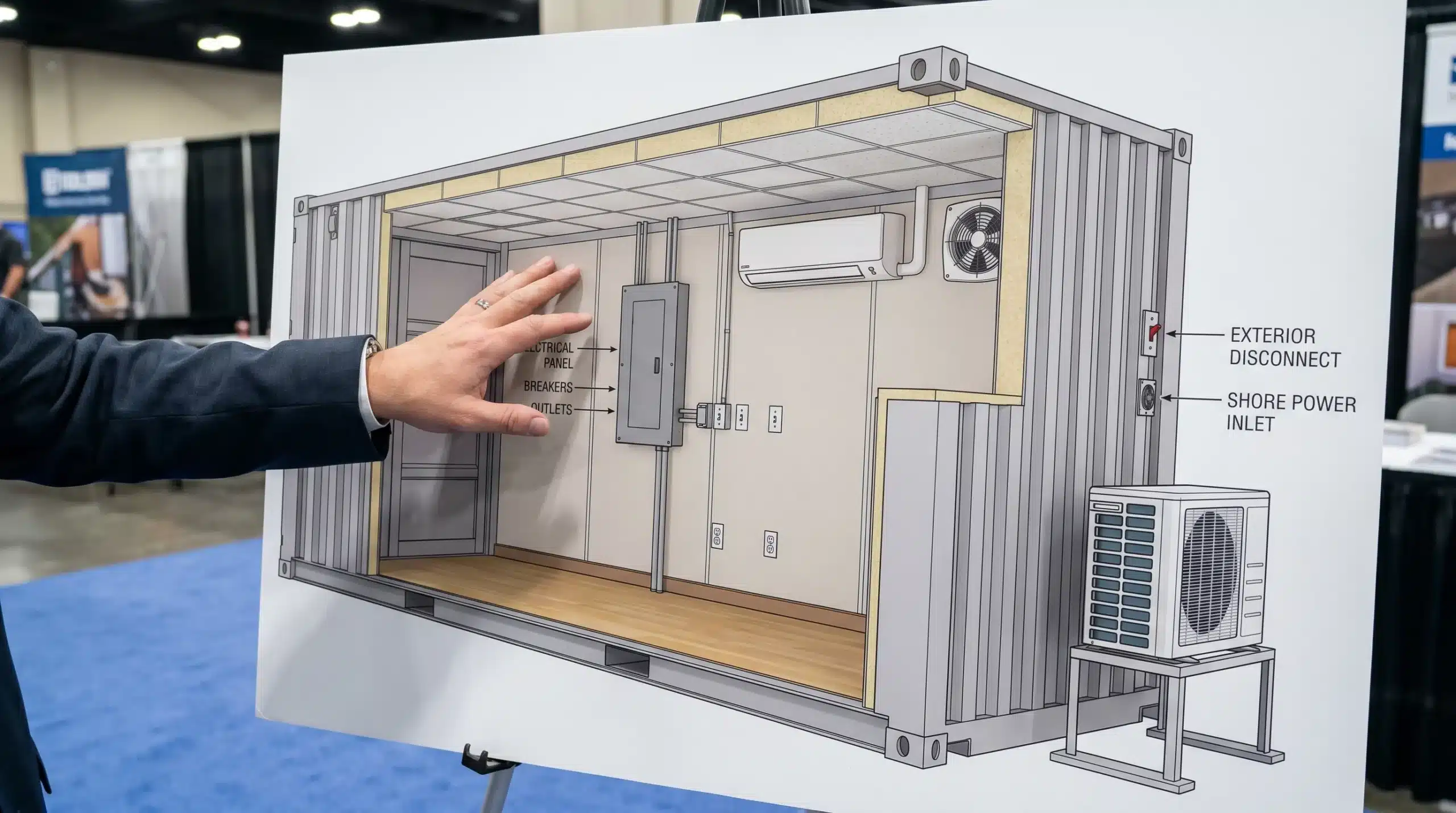
Your electrician will typically plan a small panel (load center) inside the container office and feed it from:
- A building service (subpanel feed)
- A dedicated meter/service (for standalone installs)
- A generator or hybrid power setup (remote sites)
Shore power, inlet plugs, and exterior disconnects
Many buyers want the office to be relocatable, especially for construction projects in Texas, Florida, Georgia, or Arizona where sites change.
Common approaches include:
- A shore power inlet (like an RV or equipment inlet) feeding the interior panel
- An exterior disconnect (often required by code depending on configuration)
- Hardwired conduit from a nearby building or temporary power pole
Because requirements vary by jurisdiction, plan for an electrician to confirm what your city or county expects.
A simple load planning rule that prevents most surprises
If you only do one thing early, do this: list every electrical item you want in the office and identify which ones are “always on” vs “sometimes on.”
That list helps your electrician size:
- Panel capacity
- Circuit count
- Wire gauge
- Grounding method
For code and safety, follow locally adopted standards and work with licensed pros. You can reference the NFPA overview of the National Electrical Code (NEC) for high-level context (your local authority decides what version applies).
Step 3: HVAC basics for a shipping container office (cooling, heating, ventilation)
Container offices heat up and cool down fast because steel transfers heat efficiently. HVAC is not optional in most of the U.S., it is a comfort, productivity, and moisture-control requirement.
What HVAC systems are commonly used
For many U.S. climates, a ductless mini-split heat pump is a common choice because it provides:
- Efficient cooling in hot regions (Phoenix, Miami, Houston)
- Heating in cooler seasons (Dallas, Atlanta)
- Good zone control for small spaces
Other options include window units (simpler, usually less efficient) or packaged systems depending on design.
Insulation matters as much as HVAC equipment
A shipping container office can suffer from condensation if insulation and vapor control are poorly planned.
At a high level, you want to:
- Reduce heat gain and heat loss
- Limit condensation on steel surfaces
- Maintain comfortable indoor humidity
Many builders choose closed-cell spray foam or a properly detailed insulation system because it can help with air sealing and moisture control. Your best option depends on climate, wall framing approach, and interior finish.
Ventilation and fresh air (often overlooked)
If people will work inside the container office daily, you should plan for ventilation, not just heating and cooling.
Ventilation can be addressed through:
- Mechanical ventilation (simple exhaust and intake strategies)
- HVAC-integrated solutions
- Operable windows (useful, but not always enough)
Local mechanical code requirements can apply when a space becomes “occupied.” This is one reason permits matter.
Quick HVAC sizing guidance (rule of thumb only)
Exact HVAC sizing should be done by an HVAC professional. Still, this basic idea helps early budgeting:
- Better insulation and airtightness usually means smaller HVAC needs.
- Big glass areas, poor shading, and high occupancy increase HVAC needs.
If a contractor gives you a “one-size-fits-all” HVAC plan without asking about insulation and window cutouts, treat that as a red flag.
Step 4: Permit basics for a shipping container office in the USA
Permitting is local, but the questions are predictable. In most areas, the permit trigger is not “it’s a container,” it’s that you are creating an occupied structure with electrical and mechanical systems.
What permits may apply
Depending on your city or county (and whether this is temporary or permanent), you may run into:
- Zoning approval (use, setbacks, placement rules)
- Building permit (especially if you add openings, structural changes, foundations, or permanent anchoring)
- Electrical permit (new panel, circuits, exterior disconnect)
- Mechanical permit (HVAC installation)
- Plumbing permit (if adding a bathroom or sink)
For many buyers, the key first call is your local planning/building department. If you want a starting point on where codes come from, the International Code Council (ICC) is a major U.S. code body, but your local authority decides what is adopted and enforced.
Common permit triggers (simple table)
| Scenario | Why it triggers permits | What the office owner should prepare |
|---|---|---|
| Temporary jobsite office (weeks to months) | Often treated as temporary structures, still may require zoning or temporary use approval | Site plan, placement duration, electrical hookup method |
| Permanent office use on commercial property | Occupancy, accessibility, and life safety requirements may apply | Site plan, HVAC plan, electrical plan, anchoring/foundation details |
| Cutting in windows/doors or removing wall sections | Structural modification, wind loads, framing requirements | Engineer/contractor drawings, reinforcement plan |
| Adding restroom or plumbing | Sanitary, water, venting requirements | Plumbing layout, connection plan, fixture list |
Zoning, setbacks, and HOA rules
Even if you do everything right technically, you can still get blocked by location rules.
Typical issues include:
- Minimum setbacks from property lines
- Limits on accessory structures in residential areas
- Appearance requirements in certain districts
- HOA restrictions (common in suburbs)
If you are still in the “can I place it here?” stage, this resource may help you think through the process: Container storage units permits and placement.
“Do I need a permit to deliver and place the container?”
Delivery permits are a separate question from building permits.
- Many standard deliveries do not require special transport permits.
- Some oversized loads, routes, or height constraints can trigger transport permitting.
A supplier can often help you understand delivery method and constraints. For more detail, see: Transporting a shipping container: permits, costs, timelines.
Pricing and budgeting: what to include beyond the container
A shipping container office budget usually includes more than the container price.
Plan for these cost categories:
- Container (size and condition)
- Delivery and offload (distance, access, tilt-bed vs crane requirements)
- Modifications (cutouts, windows/doors, framing, welding)
- Insulation and interior finish
- Electrical (panel, wiring, outlets, lighting)
- HVAC (equipment and install)
- Permits, drawings, inspections
Practical pricing note: Container prices vary by market and availability, and delivered cost can change significantly between metro areas (for example, Los Angeles vs Orlando vs San Antonio). The fastest way to get an accurate number is to request a delivered quote for your ZIP code with your site access details.
Delivery basics for container offices (what your site must be ready for)
Whether you are placing a container office at a jobsite in Houston, a yard outside Phoenix, or a business location near Atlanta, delivery success depends on access.
Minimum planning items typically include:
- A level, stable placement area (gravel, compacted base, or pads depending on your plan)
- Enough turning radius for the truck
- Overhead clearance (trees, wires, building overhangs)
- A clear plan for final door orientation
Global Containers Line provides fast nationwide delivery across the United States, and we coordinate delivery to your location with transparent pricing and secure online ordering.
Common mistakes to avoid
Buying the container before confirming site rules. Zoning and setbacks can stop the project even after delivery.
Underestimating HVAC needs. Steel boxes in the sun require real insulation and a properly sized system.
Assuming “shore power” is simple. Electrical permits, disconnect rules, and grounding requirements vary.
Not planning for condensation. Moisture control is a design issue, not just a dehumidifier purchase.
Frequently Asked Questions
Do I need a permit for a shipping container office? In many U.S. cities and counties, yes, especially if it will be occupied and has electrical and HVAC installed. Zoning approval, building permits, and trade permits (electrical/mechanical) are common. Always confirm with your local authority.
What power do I need for a shipping container office? Most offices need standard 120V circuits for outlets and lighting, and often a 240V circuit for HVAC (depending on the system). The safest approach is to list your equipment and have a licensed electrician size the panel and feed.
What HVAC is best for a container office in hot states like Texas, Arizona, or Florida? A ductless mini-split heat pump is a common option because it cools efficiently and can also heat in winter. The “best” choice depends on insulation, windows, sun exposure, and occupancy.
Can I use a used container for an office conversion? Yes, many buyers do. For office builds, prioritize a container that is wind and watertight, structurally solid, and suitable for modification. Ask for condition details and plan an inspection at delivery.
How fast can you deliver a container office unit? Delivery time depends on inventory availability and trucking schedules in your region. Global Containers Line offers fast nationwide delivery across the USA, and we can quote delivery to major metros and surrounding areas.
Browse available containers or request a delivered quote
If you’re planning a shipping container office and want to start with a solid, inspected container delivered to your site, Global Containers Line can help you choose the right size and condition, then coordinate fast nationwide delivery across the United States.
Browse inventory by size:
- Shop 20ft shipping containers
- Shop 40ft shipping containers
Or, if you want the quickest, most accurate price, request a delivered quote based on your ZIP code, site access, and intended use at Global Containers Line.