
A shipping and storage container is one of the fastest ways to add secure, usable space to a U.S. property without building a permanent structure from the ground up. Homeowners use them during renovations. Contractors use them to protect tools and materials. Farms, retailers, warehouses, schools, and real estate developers use them when they need tough storage that can be delivered quickly and moved if plans change.
For many buyers, the appeal is simple: a steel container gives you a lockable, weather-resistant space that can be placed on a driveway, jobsite, farmyard, commercial lot, or industrial property. With new and used options available in 10ft, 20ft, 40ft, and high cube sizes, the right container can fit anything from household overflow to full-scale business inventory.
Global Containers Line supplies inspected new and used shipping containers across the United States, with fast nationwide delivery and transparent pricing for buyers in cities such as Houston, Dallas, Atlanta, Phoenix, Miami, Los Angeles, Jacksonville, Tampa, Orlando, San Antonio, and beyond.
Quick Answer: What Can You Use a Shipping and Storage Container For?
A shipping and storage container can be used for secure property storage, construction site storage, farm equipment protection, retail inventory overflow, moving and renovation storage, workshop space, equipment staging, and custom container projects. The best use depends on container size, condition, access needs, local property rules, and whether you need temporary or long-term placement.
In most cases, a 20ft container works well for homeowners, small businesses, and tighter sites. A 40ft container is better for contractors, farms, warehouses, and commercial properties that need more floor space.
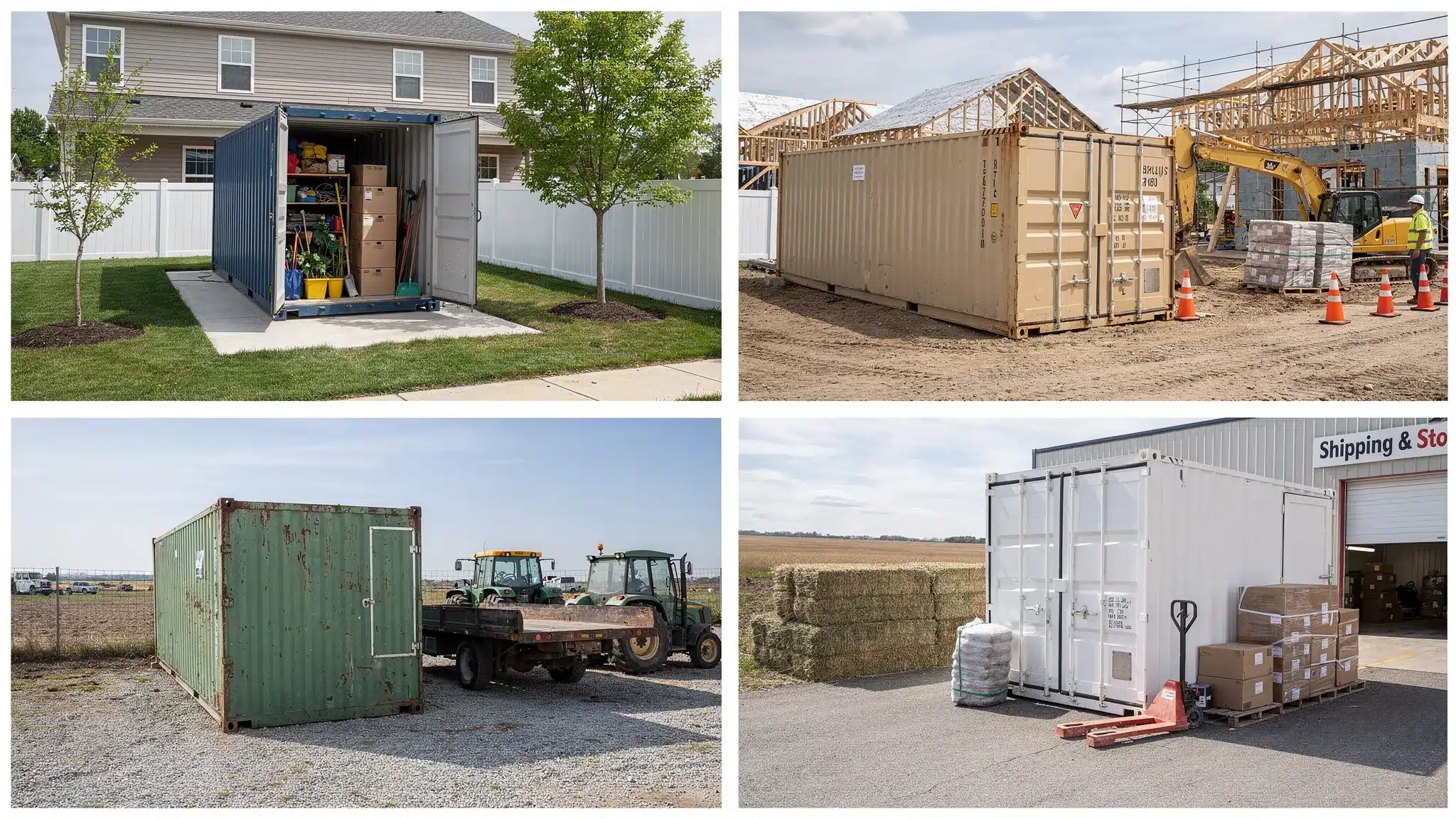
Why Shipping and Storage Containers Work Well for U.S. Properties
Shipping containers were designed to move heavy cargo through demanding transportation environments. That makes them practical for property owners who need durable storage without waiting months for new construction. They are built from steel, have strong floors, and include large cargo doors that make loading tools, pallets, furniture, equipment, and supplies easier.
For U.S. buyers, containers are also attractive because they can support short-term and long-term needs. A homeowner in Phoenix may need temporary storage during a remodel. A contractor in Atlanta may need a secure tool container for each jobsite. A farm owner in Texas may need year-round storage for fencing materials, feed, or equipment. A retailer in Miami may need overflow space before peak season.
A well-selected container can also reduce clutter, improve site organization, and protect valuable items from rain, wind, sun exposure, and casual theft. For businesses, that can mean fewer delays, less material loss, and better use of existing property space.
Shipping and Storage Container Uses by Property Type
The best container use depends on your property type, available space, and what you plan to store. The table below gives a quick comparison for common U.S. property needs.
| Property type | Common uses | Best-fit size | What to confirm before buying |
|---|---|---|---|
| Residential homes | Renovation storage, seasonal items, garage overflow, moving storage | 10ft or 20ft | HOA rules, driveway access, door orientation |
| Construction sites | Tools, lumber, equipment, jobsite supplies, temporary staging | 20ft or 40ft | Delivery access, lock security, level ground |
| Farms and ranches | Feed, tack, fencing, machinery parts, ATVs, seed storage | 20ft, 40ft, or high cube | Ventilation, pest control, rural truck access |
| Retail and small business | Inventory overflow, fixtures, records, seasonal stock | 20ft or 40ft | Loading access, permits, moisture control |
| Warehouses and logistics yards | Pallet storage, returns, spare parts, overflow storage | 40ft or 40ft high cube | Forklift access, placement plan, traffic flow |
| Real estate developments | Staging materials, maintenance equipment, tenant turnover storage | 20ft or 40ft | Site phasing, appearance, local placement rules |
| Municipal and event properties | Sports equipment, emergency supplies, event materials | 20ft or 40ft | Public access, security, code requirements |
Residential Property Uses
For homeowners, a shipping and storage container is often a practical alternative to renting off-site storage. You keep items close to home while freeing up garage, basement, or driveway space. Common residential uses include storing furniture during remodeling, protecting lawn equipment, holding seasonal decorations, organizing tools, or keeping belongings on-site during a move.
A 20ft shipping container is often the most manageable size for residential properties because it offers useful capacity while taking up less space than a 40ft unit. It can fit many driveways, side yards, and rural residential lots, but you should still confirm local rules, setbacks, HOA requirements, and delivery access before ordering.
If appearance matters, a new or one-trip container may be the better choice. If the main goal is practical storage at a lower cost, an inspected used wind and watertight container may be enough.
Construction Site Uses
Construction companies rely on containers because they are tough, portable, and secure. A container can store tools, copper, lumber, drywall, generators, safety gear, temporary fencing, hardware, and equipment that would otherwise be exposed or hauled back and forth each day.
A 20ft unit works well for smaller jobsites and tight urban locations. A 40ft shipping container is a better fit for large construction projects, commercial builds, roadwork staging areas, and multi-phase developments where more materials need to stay on-site.
Good organization is important. Contractors should keep walkways clear, stack materials safely, and avoid blocking access. OSHA provides general guidance on safe material storage under its materials handling and storage standards, which is useful when containers become part of an active jobsite layout.
Farm, Ranch, and Rural Property Uses
Farmers and ranch owners often need storage that can handle weather, pests, and rough daily use. A container can store feed bags, fencing supplies, irrigation parts, tools, spare machinery components, tack, hay equipment, seed, and seasonal supplies.
Rural buyers should think carefully about delivery access. Long gravel drives, soft ground, low tree limbs, cattle gates, narrow entrances, and uneven terrain can affect delivery. If you are placing a container in a field or barnyard, a compacted gravel pad, concrete blocks, or railroad ties can help keep the unit level and improve drainage.
For feed, paper goods, seed, or other moisture-sensitive items, ask about ventilation and condensation control. A wind and watertight container helps keep weather out, but interior moisture can still build up if air circulation is poor or temperature swings are extreme.
Retail, Office, and Small Business Uses
A shipping and storage container can help small businesses handle growth without leasing larger space right away. Retail stores use containers for seasonal inventory, display fixtures, packaging supplies, archived records, and extra equipment. E-commerce sellers can use them for overflow stock, returns, and shipping materials.
For restaurants, event companies, landscapers, repair shops, and contractors, containers can store supplies close to where work happens. This is especially useful in busy U.S. markets where commercial square footage is expensive and warehouse availability can be limited.
If customers or employees will see the container daily, condition and appearance matter. Newer containers usually look cleaner and are often preferred for retail, office, and customer-facing properties.
Real Estate and Multi-Property Uses
Real estate developers, property managers, and multifamily owners use containers to support construction, renovations, tenant turnovers, landscaping, and maintenance operations. A container can hold appliances, flooring, fixtures, tools, paint, and emergency repair materials.
For phased developments, containers can move from one part of the property to another as work progresses. For apartment communities or commercial properties, a container can reduce clutter in maintenance rooms and keep high-value equipment in a controlled location.
Before placing a container on a developed property, consider visibility, access, fire lanes, parking rules, drainage, and neighboring property lines. Placement is not only about where the container fits, it is also about how people and vehicles move around it.
Choosing the Right Size for Your Property
Choosing the right size is one of the most important buying decisions. The largest container is not always the best choice. You need to balance capacity, access, delivery clearance, budget, and how often you will need to retrieve items.
| Container size | Approximate exterior footprint | Best for | Key advantage |
|---|---|---|---|
| 10ft | 10 ft by 8 ft | Tight residential sites, small tool storage, limited-space properties | Compact placement |
| 20ft | 20 ft by 8 ft | Home storage, small business inventory, jobsite tools, farm supplies | Strong balance of size and flexibility |
| 40ft | 40 ft by 8 ft | Large jobsites, commercial stock, farm equipment, warehouse overflow | More storage value per square foot |
| 40ft high cube | 40 ft by 8 ft, taller height | Bulky items, tall equipment, conversion projects, palletized goods | Extra vertical clearance |
If you are unsure, start with what you need to store, how often you need access, and how much room the delivery truck will have. A 20ft container may be easier to place on tighter properties, while a 40ft unit may be more cost-effective for large-volume storage.
New vs Used Containers for Property Storage
Condition matters because not every container is meant for the same type of use. A storage container for tools does not need to look the same as a container being used for a customer-facing retail project. A container used for export or heavy cargo also has different requirements than a container used for household storage.
Here are the most common condition options buyers compare:
| Condition | What it usually means | Best uses |
|---|---|---|
| New or one-trip | Minimal wear, cleaner appearance, usually only one cargo trip | Residential projects, business sites, conversions, visible locations |
| Cargo-worthy | Structurally sound and suitable for cargo use, though not cosmetically new | Shipping, heavy storage, commercial use |
| Wind and watertight | Used container that keeps out wind and rain when doors and seals are closed | General storage, jobsite storage, farm storage |
| As-is | May have leaks, damage, door issues, or floor concerns | Only for buyers who can inspect and repair |
Global Containers Line offers new and used shipping containers that are cargo-worthy, wind and watertight, and inspected before dispatch. Used units may show dents, surface rust, patches, or markings, but they should still perform for storage when the condition is properly verified.
Pricing: What Affects the Cost of a Shipping and Storage Container?
Shipping and storage container prices vary across the United States because inventory, delivery distance, size, condition, and market demand change by region. A buyer in Houston may see different pricing than a buyer in Phoenix, Atlanta, Miami, Dallas, or Los Angeles due to port access, trucking costs, and local availability.
As a general 2026 planning range, many U.S. buyers see used 20ft storage containers in the low-to-mid thousands, often around $1,800-$3,500 depending on condition and location. Used 40ft containers often fall roughly around $2,500-$5,000, with new, one-trip, high cube, refrigerated, or modified units costing more. Exact delivered pricing depends on your ZIP code, offload method, site access, and current inventory.
| Cost factor | How it affects price | Buyer tip |
|---|---|---|
| Size | Larger containers usually cost more overall but may offer better storage value per square foot | Compare 20ft and 40ft delivered pricing before deciding |
| Condition | New and one-trip units cost more than used wind and watertight units | Match condition to use, not just appearance |
| Delivery distance | Longer routes and difficult access can increase total cost | Request a delivered quote, not just a unit price |
| Local inventory | High-demand areas may see price swings | Buy ahead of peak construction or moving seasons when possible |
| Site requirements | Cranes, permits, grading, or special offload equipment can add cost | Prepare the site before delivery day |
| Add-ons | Lockboxes, vents, ramps, shelving, and modifications increase total cost | Decide which upgrades are essential before ordering |
The safest way to compare prices is to ask for an itemized delivered quote. Global Containers Line focuses on competitive pricing with no hidden fees, secure online ordering, and clear container condition details before dispatch.
Delivery and Site Preparation Across the United States
Delivery is a major part of buying a container. A low advertised price is not helpful if delivery is unclear, delayed, or more expensive than expected. Global Containers Line offers fast nationwide delivery across the United States, serving major cities, suburbs, rural properties, farms, commercial sites, and construction locations.
Before delivery, prepare your site so the container can be placed safely and correctly. A good delivery plan helps avoid re-delivery charges, delays, or placement issues.
Key site preparation steps include:
- Choose a level area with solid ground, gravel, asphalt, concrete, or properly compacted soil.
- Confirm the delivery truck has enough straight-line space to enter, unload, and exit safely.
- Remove low branches, low wires, parked vehicles, debris, and equipment from the delivery path.
- Decide which way the cargo doors should face before the driver arrives.
- Plan for drainage so water does not pool under or around the container.
- Check local property rules, permits, setbacks, HOA requirements, and fire lane access.
Delivery needs can differ by city and property type. A 20ft container for a residential driveway in Dallas is a different delivery job than a 40ft high cube container for a warehouse yard in Los Angeles or a ranch property outside San Antonio. Providing photos, measurements, gate widths, and ZIP code details can help your supplier quote and schedule accurately.
Permits, Placement, and Local Rules
Permit requirements vary by city, county, zoning district, and intended use. Some properties allow temporary storage containers with minimal paperwork. Others require permits, screening, setbacks, foundation details, or time limits. If the container will be modified into an office, retail space, workshop, or living area, you should expect more code review.
For occupied or modified container projects, local building departments may reference model codes published by the International Code Council. Always verify rules with your local authority before buying, especially if the container will be connected to utilities, placed permanently, stacked, altered structurally, or used by employees or the public.
Placement also affects long-term performance. Containers should sit level so doors open and close properly. Elevating the unit slightly can help reduce moisture, rust, and floor issues over time. On soft soil, consider gravel, concrete piers, railroad ties, or a pad designed for the weight and use of the container.
How to Choose the Best Container for Your Use Case
A good container purchase starts with a practical question: What problem does the container need to solve? If you need temporary home storage, a smaller used unit may be enough. If you need business inventory storage in a visible area, a cleaner one-trip unit may be worth the higher cost. If you need large-volume jobsite storage, a 40ft container may deliver the best value.
Ask these questions before you buy:
- What items will go inside, and are they moisture-sensitive?
- How often will someone need to access the container?
- Is appearance important to neighbors, customers, tenants, or inspectors?
- Will the container be temporary, seasonal, or permanent?
- Can a delivery truck safely reach the placement area?
- Do you need room for shelving, pallets, ramps, or equipment movement?
These answers will help you decide between 20ft, 40ft, high cube, new, used, cargo-worthy, and wind and watertight options.
Why Buy From Global Containers Line?
Global Containers Line is a trusted U.S.-based supplier of new and used shipping containers for sale. We provide 10ft, 20ft, 40ft, and high cube containers for storage, construction, commercial, residential, agricultural, and custom container projects.
Every container is inspected before dispatch, with cargo-worthy and wind and watertight options available for buyers who need dependable performance. Customers benefit from transparent pricing, secure online checkout, multiple sizes in stock, and fast nationwide delivery across the United States.
Whether you are buying one container for a home renovation or multiple units for a commercial property, our team can help you compare sizes, understand condition options, and plan delivery to your site.
Frequently Asked Questions
What is a shipping and storage container? A shipping and storage container is a steel cargo container used for secure storage, transportation, jobsite support, farm storage, commercial inventory, and custom projects. It is commonly available in 10ft, 20ft, 40ft, and high cube sizes.
What is the most common container size for property storage? The 20ft container is often the most flexible choice for homeowners, small businesses, farms, and smaller jobsites. The 40ft container is better when you need more floor space for commercial inventory, construction materials, or large equipment.
How much does a shipping and storage container cost in the USA? Pricing depends on size, condition, delivery distance, local inventory, and add-ons. Used 20ft containers often fall in the low-to-mid thousands, while used 40ft units typically cost more. New, one-trip, high cube, refrigerated, and modified containers cost more. Request a delivered quote for accurate pricing.
Are used shipping containers wind and watertight? Many used containers are sold as wind and watertight, meaning they are designed to keep out wind and rain when closed properly. Always confirm the condition grade, door seals, roof, floor, and inspection details before buying.
Do I need a permit to place a storage container on my property? It depends on your city, county, zoning, HOA, and intended use. Temporary storage may have fewer requirements than permanent placement or modified container projects. Always check local rules before delivery.
How fast can a container be delivered? Delivery time depends on inventory, location, carrier availability, site access, and order details. Global Containers Line offers fast nationwide delivery across the United States and can help coordinate delivery based on your ZIP code and container choice.
Can I use a shipping container for more than storage? Yes. Many buyers use containers for workshops, pop-up retail, mobile offices, farm support, equipment rooms, event storage, and custom builds. Modified or occupied uses may require permits, insulation, ventilation, electrical planning, and professional construction support.
Browse Shipping and Storage Containers for Your Property
If you are ready to add secure space to your home, farm, business, jobsite, or commercial property, Global Containers Line can help you choose the right container and coordinate fast nationwide delivery.
Browse available 20ft shipping containers for flexible storage or compare 40ft shipping containers for larger projects. For current pricing, availability, and delivery to your U.S. location, request a quote from Global Containers Line today.