
Steel shipping containers are tough, secure, and built to handle harsh conditions. The challenge is that steel also transfers heat fast, which means an uninsulated container can feel like an oven in Phoenix and a freezer in Minnesota. If you are planning storage, a jobsite office, a workshop, or a container conversion, choosing the right insulated shipping container setup is one of the biggest decisions you will make for comfort, moisture control, and long-term durability.
This guide breaks down the best insulation options for real U.S. climates (hot-humid, hot-dry, cold, coastal, and mixed), plus what insulation usually costs, what container condition to start with, and how delivery works when buying nationwide.
Quick answer: what is the best insulation for a shipping container?
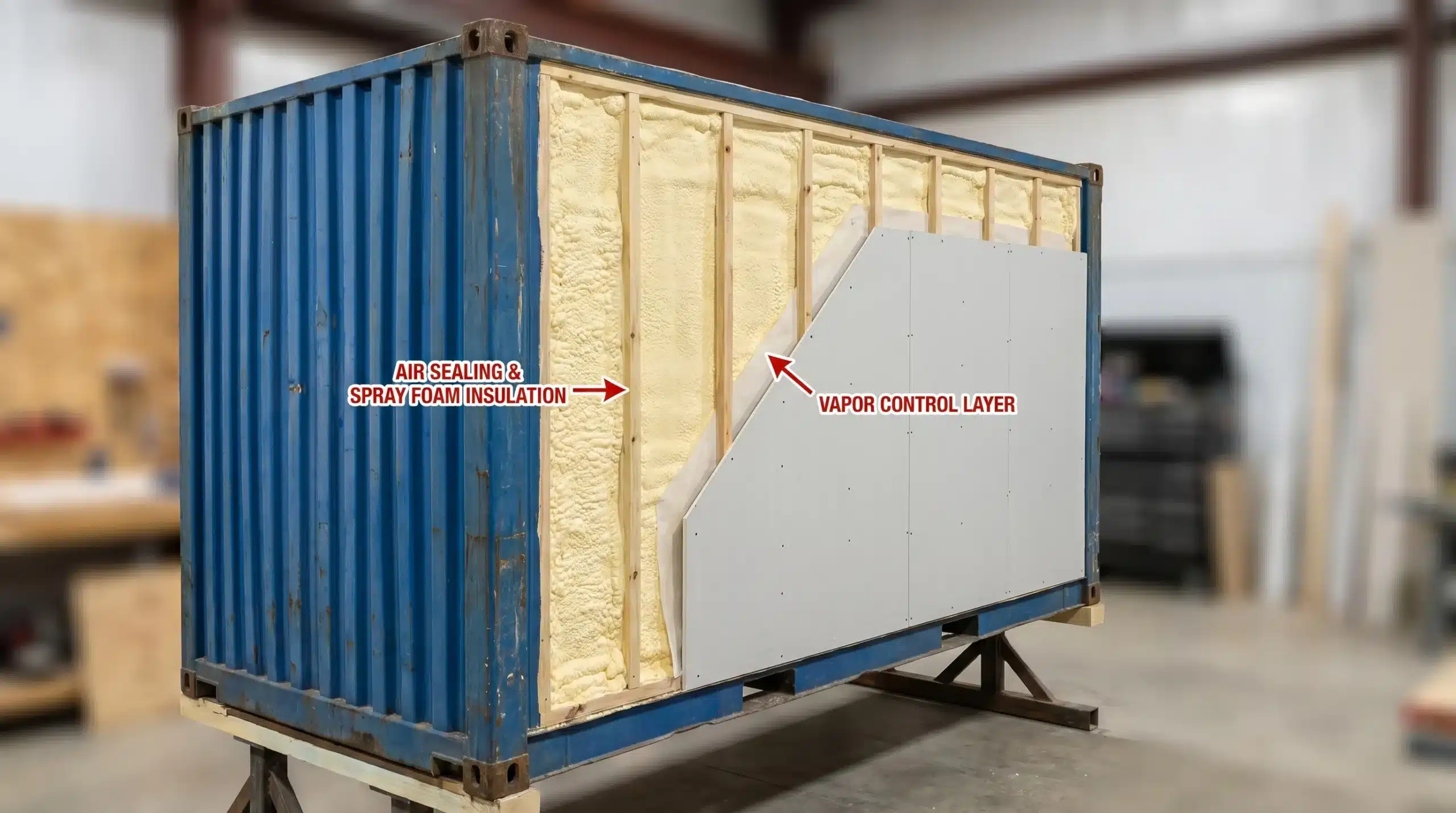
For most U.S. climates and use cases, closed-cell spray foam is the top all-around choice because it air-seals, resists moisture, and delivers high R-value per inch in a thin wall assembly. That said, the “best” insulation depends on:
- Your climate (humidity and temperature swings matter)
- Whether people will occupy the space (code and fire-safety requirements can apply)
- Whether you need maximum interior space (thinner systems help)
- Your budget and timeline
What makes insulating a shipping container different?
Shipping containers are not like wood-framed buildings. They are a steel shell with thin walls and structural ribs. That creates a few predictable issues:
Thermal bridging through steel
Steel conducts heat well. Even if you insulate between studs, heat can still move through the steel framing and ribs, reducing real-world performance. A good plan aims for as much continuous insulation as possible.
Condensation risk (especially in humid states)
Warm, moist air hitting a cooler steel wall can condense into water. Over time, that can lead to:
- Rust and corrosion
- Mold and mildew on interior finishes
- Wet floors and damaged contents
This is why insulation choice is not just about R-value. It is also about air sealing and vapor control.
Limited wall thickness
Most buyers want insulation without giving up too much interior space. A 20ft container is already narrow inside, so a thick wall build-out can make it feel tight.
Insulated shipping container vs refrigerated (reefer) container
Buyers often ask if they should just buy a reefer.
- An insulated shipping container usually means a standard dry container that you insulate (spray foam, rigid board, etc.) for comfort and moisture control.
- A refrigerated container (reefer) is a factory-insulated unit designed for temperature-controlled cargo, typically with a refrigeration system and specific power needs.
If you need to actively hold cold temperatures (food, pharmaceuticals, cold storage), a reefer can make sense. If you need comfortable space for people, tools, inventory, or a conversion, insulating a standard container is often the more practical route.
Best insulation types for shipping containers (pros, cons, and where they work best)
Below is a practical comparison of common insulation options used in container projects. R-values vary by product, thickness, and installation quality. For general reference on insulation performance, the U.S. Department of Energy has a helpful overview of insulation materials and R-value basics on energy.gov.
| Insulation type | Typical R-value per inch (approx.) | Strengths for containers | Watch-outs | Best fit climates |
|---|---|---|---|---|
| Closed-cell spray foam | ~R-6 to R-7 | Excellent air seal, strong moisture resistance, thin high-performance layer | Higher cost, professional install, usually needs code-compliant ignition/thermal barrier for occupied spaces | Hot-humid (FL, TX Gulf), cold (MN), mixed (TN, NC), coastal |
| Open-cell spray foam | ~R-3.5 to R-4 | Air sealing, lower cost than closed-cell | Can absorb moisture, not ideal where condensation risk is high without a smart assembly | Drier climates or interior partitions |
| Polyiso rigid foam board | ~R-5.5 to R-6.5 | High R/inch, good for continuous insulation | Foil facers can trap moisture if misused, needs careful sealing | Hot-dry, mixed, many conversions with good detailing |
| XPS rigid foam board | ~R-5 | Good moisture resistance, easy to work with | Cost and environmental trade-offs, seams must be sealed | Mixed and cold when installed correctly |
| EPS rigid foam board | ~R-3.6 to R-4.2 | Budget-friendly, workable continuous insulation | Thicker for same R-value, needs protection | Mild and mixed climates on a budget |
| Mineral wool (rockwool) | ~R-4 to R-4.3 | Fire resistance, sound control, moisture-tolerant | Needs framing cavity, does not air-seal on its own | Great behind an air-sealed layer, cold/mixed |
| Fiberglass batts | ~R-3 to R-3.4 | Low material cost, widely available | Poor air sealing, performance drops if it gets damp, not ideal against steel without careful vapor/air control | Only when paired with excellent air sealing and vapor strategy |
Recommendation for most buyers: closed-cell spray foam (with the right finish)
If you are insulating a container in Houston, Miami, Tampa, New Orleans, or any humid region, the biggest enemy is moisture. Closed-cell spray foam is popular because it helps reduce condensation on the steel shell by limiting warm moist air from reaching cold steel.
For occupied projects (office, studio, living space), plan for code-compliant interior finishing. Many jurisdictions require an ignition barrier or thermal barrier over foam in occupied spaces. Always confirm local requirements.
Best budget-friendly option: rigid foam board plus airtight seams
If you want a DIY-friendly approach, rigid foam boards can work well when you take air sealing seriously. The common failure point is leaky seams that allow humid air to hit steel.
A practical approach many builders use is continuous rigid foam with taped seams, plus careful detailing around corrugations and framing.
Best insulation choices by U.S. climate (real-world guidance)
The United States spans multiple climate zones. Instead of chasing one “perfect” insulation, match your assembly to the conditions.
Hot-humid climates (Florida, Gulf Coast Texas, Louisiana, Georgia)
Common cities: Miami, Orlando, Tampa, Jacksonville, Houston, New Orleans, Mobile, Atlanta.
Main goal: control humidity and stop condensation.
Best options:
- Closed-cell spray foam directly on steel, then interior framing and finish
- Hybrid system: thin closed-cell foam for condensation control, then additional insulation if needed
Helpful add-ons:
- Passive vents or a powered ventilation plan (depending on use)
- A dehumidifier for storage containers holding sensitive goods
Hot-dry climates (Arizona, Nevada, inland California)
Common cities: Phoenix, Las Vegas, parts of Southern California, inland Texas.
Main goal: reduce extreme heat gain and manage big day-night swings.
Best options:
- Closed-cell spray foam for air sealing and high R/inch
- Polyiso rigid board for strong thermal performance (with well-sealed joints)
- Consider reflective coatings or shading strategies (insulation works best when paired with solar control)
Cold and very cold climates (Upper Midwest, Northern Plains, Mountain regions)
Common regions: Minnesota, North Dakota, Montana, Wisconsin, higher elevations in Colorado.
Main goal: keep heat in and prevent interior moisture from condensing inside the walls.
Best options:
- Closed-cell spray foam for air sealing (air leaks matter more in cold climates)
- Rigid foam plus a well-designed air barrier and careful moisture detailing
In cold areas, small gaps and air leaks can create frost and moisture problems. Airtightness is often as important as R-value.
Marine and coastal climates (Pacific Northwest, coastal Northeast)
Common cities: Seattle area, Portland area, coastal New England.
Main goal: manage moisture while maintaining comfort.
Best options:
- Closed-cell spray foam, especially where wind-driven moisture and damp conditions are common
- Hybrid systems that include air sealing plus a moisture-tolerant insulation layer
Mixed climates (Mid-Atlantic, Midwest, much of the South interior)
Common cities: Dallas, Nashville, Charlotte, St. Louis, Kansas City.
Main goal: handle both heating and cooling seasons.
Best options:
- Closed-cell spray foam for a simple, robust assembly
- Rigid foam plus mineral wool if you want strong fire resistance and sound control (with good air sealing)
How much does an insulated shipping container cost?
Pricing depends on two big buckets: the container itself and the insulation build-out.
1) Container price drivers
Your delivered container price typically depends on:
- Size (10ft, 20ft, 40ft, high cube)
- Condition (new one-trip vs used cargo-worthy vs wind and watertight)
- Your delivery zip code and distance to the nearest yard
- Site access and offload method (tilt-bed vs crane)
If you want a price baseline by market, you can also review our location-specific pricing guides across cities like Houston, Dallas, Phoenix, Miami, and Atlanta in our Container Industry Insights section.
2) Insulation and interior build-out drivers
Insulation cost varies based on:
- Insulation type (spray foam is usually higher upfront than batts)
- Desired R-value and thickness
- Whether you are also finishing the interior (plywood, wall panels, drywall)
- Labor rates in your area
- Added systems like HVAC, electrical, and ventilation
Rule of thumb: if the container will be occupied or must protect moisture-sensitive inventory, it is usually worth budgeting for an insulation approach that includes air sealing and condensation control, not just “some insulation.”
What container condition should you start with before insulating?
Insulation does not fix a bad container. If the shell leaks, moisture will get into your insulation and finishes.
For most insulation projects, start with a container that is:
- Cargo-worthy (structurally sound)
- Wind and watertight (no active leaks)
- Thoroughly inspected for door seal integrity, floor condition, and roof damage
At Global Containers Line, our containers are cargo-worthy, wind and watertight, and inspected before dispatch, which gives you a better starting point for insulation and build-outs.
Delivery considerations for insulated container projects
Whether you are buying in Texas, Florida, Georgia, Arizona, or anywhere else, delivery planning is part of the insulation decision because access affects where and how the container can be placed.
Common delivery questions buyers ask
How fast can you deliver? Delivery speed depends on inventory location and trucking schedules, but we offer fast nationwide delivery across the United States.
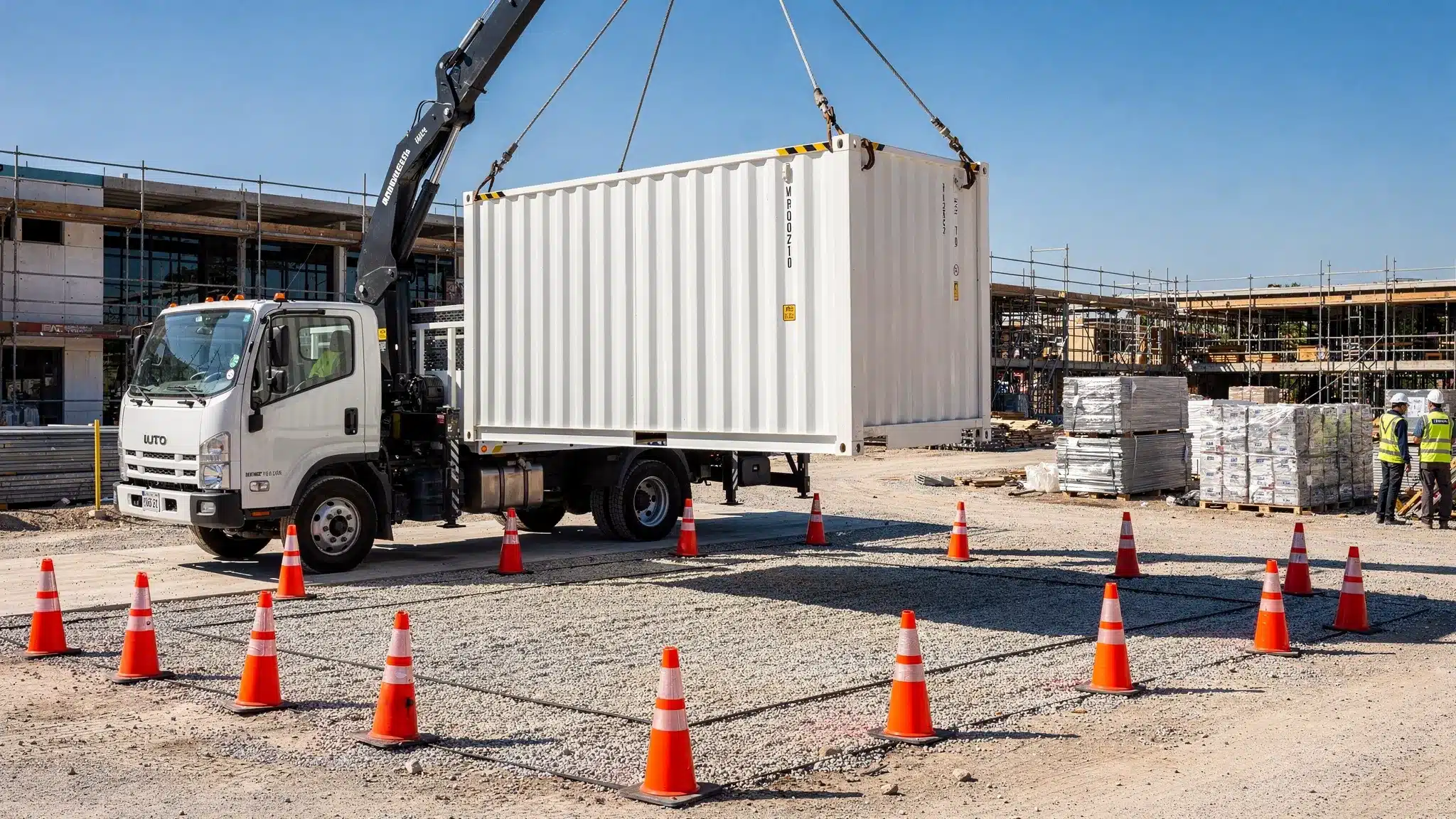
Do I need special equipment? Many residential and jobsite deliveries use tilt-bed service, but tight sites or precise placement may require a crane or specialized offload.
What do I need to prepare? Plan for:
- A level, well-drained base
- Clearance for the truck to enter, turn, and unload
- Overhead clearance for power lines and tree limbs
For a deeper breakdown, see our guide on transporting a shipping container (permits, costs, timelines).
20ft vs 40ft insulated shipping containers: which is better?
Choosing the right size affects insulation cost, comfort, and usability.
20ft containers
A 20ft is a great fit for:
- Secure storage with humidity control
- Small workshops
- Equipment rooms
- Compact offices
Browse options here: 20ft shipping containers for sale.
40ft containers
A 40ft is better when you need:
- More usable space for a build-out
- Separate zones (storage plus a small office)
- Larger inventory or equipment capacity
Browse options here: 40ft shipping containers for sale.
If you are unsure, our Ultimate Shipping Container Buying Guide walks through size planning, site access, and condition selection.
A simple “best insulation” decision guide (featured snippet friendly)
Use this quick guide to narrow your choice:
- Best overall for most U.S. climates: closed-cell spray foam
- Best for hot-humid areas (Florida, Gulf Coast): closed-cell spray foam (condensation control)
- Best for hot-dry areas (Arizona): closed-cell spray foam or polyiso rigid board (plus shading/solar control)
- Best for cold climates: closed-cell spray foam or airtight rigid foam assemblies
- Best budget approach: rigid foam board with sealed seams (plus ventilation plan)
Frequently Asked Questions
What is an insulated shipping container? An insulated shipping container is typically a standard steel container that has been fitted with insulation (spray foam, rigid board, batts, or hybrid systems) to reduce heat transfer and control condensation.
Does a shipping container need insulation in Florida or Texas? In most of Florida and the Gulf Coast (including Houston), insulation is strongly recommended because heat and humidity can cause heavy condensation and interior temperature spikes.
Is spray foam safe in a shipping container? Spray foam can be a strong option for containers, but occupied spaces may require a code-compliant ignition or thermal barrier. Always confirm local building and fire-safety requirements for your city or county.
How do I prevent condensation inside a container? Start with a wind and watertight container, use an insulation method that air-seals (often closed-cell spray foam), and add ventilation or dehumidification when storing moisture-sensitive items.
Can you deliver containers nationwide? Yes. Global Containers Line offers fast nationwide delivery across the United States, including major markets like Houston, Dallas, Atlanta, Phoenix, Miami, Los Angeles, Jacksonville, Orlando, Tampa, and San Antonio.
Browse insulated-ready containers and get a delivered quote
If you are planning an insulated shipping container for storage, a jobsite build, or a conversion project, start with a container you can trust. Global Containers Line is a USA-based supplier of new and used shipping containers that are cargo-worthy, wind and watertight, and inspected before dispatch, with transparent pricing, secure checkout, and fast nationwide delivery.
Browse inventory and sizing options:
Need help choosing insulation-ready condition, size, and delivery setup for your location? Request a delivered quote from Global Containers Line and we will help you match the right container to your climate and use case.