
If you’re searching “conex containers for sale near me,” you’re usually trying to solve two problems fast: find a container you can trust, and avoid surprises when it shows up at your site.
The good news is that shipping containers are built tough. The bad news is that “tough” doesn’t mean “problem-free,” especially with used units. This inspection checklist is designed to help U.S. buyers quickly confirm condition, spot deal-breakers, and ask the right pricing and delivery questions before money changes hands.
What counts as a “conex container,” and why condition labels matter
“Conex” is a common U.S. term for an intermodal shipping container (typically 10ft, 20ft, or 40ft). When you shop locally in places like Houston, Dallas, Atlanta, Phoenix, Miami, Orlando, or Los Angeles, you’ll hear sellers use condition labels that can mean different things depending on who’s selling.
Here’s a simple way to think about the most common grades.
| Condition label | What it usually means | Best for | What to verify before buying |
|---|---|---|---|
| New / One-trip | Minimal wear, typically used once for cargo | Retail storage, conversions, long-term ownership | Paint condition, dents, door operation, delivery access |
| Cargo-worthy (CW) | Suitable for ocean transport, often aligned with CSC requirements for shipping | Export, freight use, high-trust storage | CSC plate status, structural integrity, door sealing |
| Wind & watertight (WWT) | Keeps out wind and water, may have cosmetic dents/rust | On-site storage, farms, job sites | Roof integrity, door gaskets, floor condition |
| As-is | Cheapest tier, may have leaks, damage, or missing parts | Parts, short-term, budget storage (with risk) | Expect repairs, confirm issues in writing |
For shipping use, the reference framework is the International Convention for Safe Containers (CSC). If you need the unit to be shippable, you should understand what the CSC plate indicates and whether it’s current. You can read more background from the International Maritime Organization (IMO).
Before you inspect: 5 details to confirm (saves time and money)
Even when a container is “near you,” the smartest buyers clarify the basics before scheduling a viewing or accepting delivery.
- Size and height: 20ft vs 40ft, and Standard vs High Cube (extra height matters for door clearance and permits).
- Your intended use: storage, export shipping, construction site storage, retail, or a build-out project.
- Seller’s condition promise in plain English: “No active leaks,” “doors seal fully,” “floor is solid,” “cargo-worthy with CSC plate,” etc.
- What the price includes: container cost, taxes if applicable, delivery, and offload.
- How it will be delivered: tilt-bed, flatbed, or crane, and what your site can accommodate.
If you’re comparing quotes across cities or states (for example, Texas vs Florida vs California), remember: delivered price can swing significantly based on trucking distance, access constraints, and offload method.
Conex container inspection checklist (use this on-site or on delivery)
If you can inspect in person, bring a flashlight, work gloves, and a phone for photos. If you’re buying online, you can still use this checklist to request specific photos and short videos.
1) Start with the big picture: square, level, and structurally sound
A container that isn’t square can create constant headaches: doors won’t seal, water intrusion becomes more likely, and modification work gets more expensive.
Check:
- Is the container sitting level? If it’s twisted on uneven ground, doors might look “bad” when the container itself is simply racked.
- Corner castings: look for cracks, heavy deformation, or signs of major impact.
- Top and bottom rails: moderate dents can be cosmetic, but sharp bends near corners can be structural.
2) Roof inspection (one of the most important leak indicators)
Most water problems start at the roof. Many buyers only look at doors and walls, then discover leaks after the first heavy rain.
Check:
- Standing water “dish” areas: ponding can indicate roof deformation.
- Patches and welds: patches are not always bad, but sloppy or extensive patching is a risk.
- Pinholes: tiny rust-through points can leak significantly.
Tip: If you cannot climb safely, ask the seller for roof photos from multiple angles, including close-ups of any repaired areas.
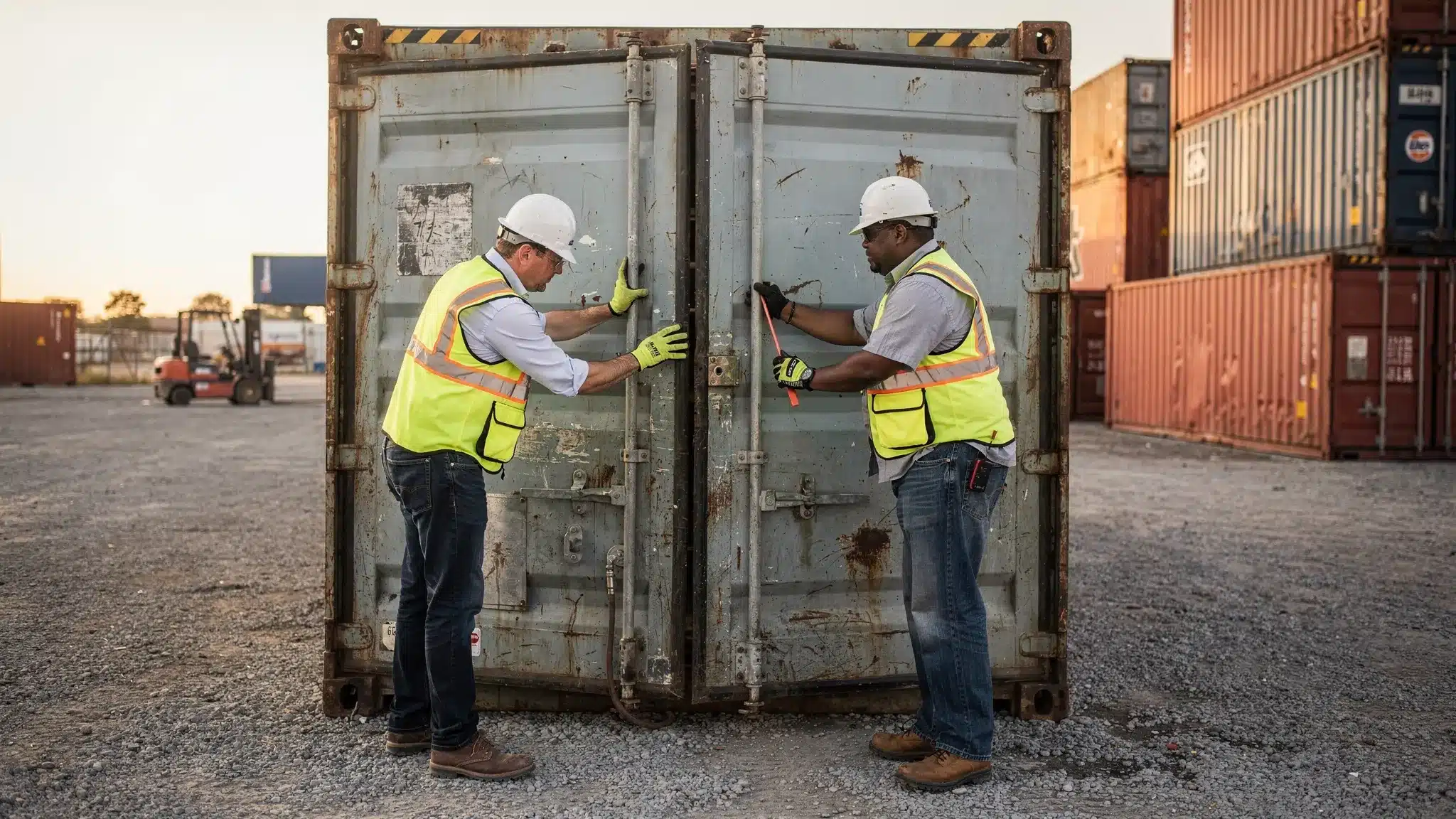
3) Doors: operation, seal, and security
Doors are the most-used moving parts, and repairs can be annoying and costly.
Check:
- Open and close both doors fully: they should swing smoothly without forcing.
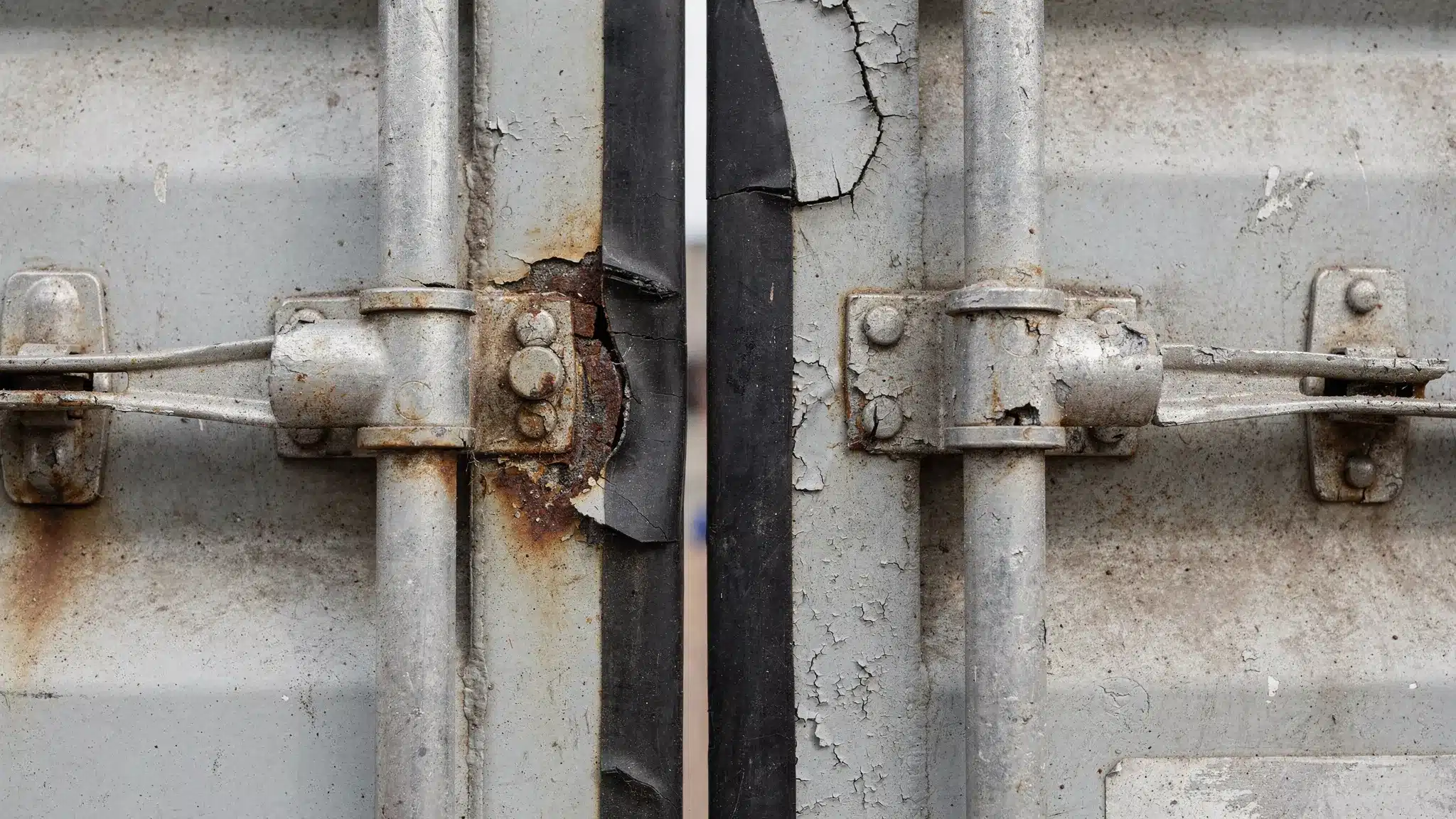
- Door gaskets (rubber seals): look for missing sections, hard cracking, or gaps.
- Locking bars and cam keepers: should latch securely.
- Light test: close doors and look for daylight around seals (small slivers may be manageable for storage units, but should be disclosed).
4) Floor and underside: don’t skip it
Floors determine whether a container is truly usable for storage and many construction or business applications.
Check:
- Soft spots: walk the full interior, especially near the door end.
- Delamination or splintering: watch for areas that look “puffed,” broken, or heavily oil-soaked.
- Previous spills or chemical staining: strong odors can be very hard to remove.
- Underside crossmembers (if visible): look for heavy corrosion or missing structure.
If you’re buying for a farm, ranch, or job site, floor integrity is often the difference between a good deal and a constant maintenance problem.
5) Interior walls: rust, holes, and odor
A container can look fine outside and still be unpleasant or compromised inside.
Check:
- Surface rust vs rust-through: surface rust is common and often manageable; holes are not.
- Moisture signs: dampness, mold, or water tracks on walls.
- Odor: musty smells can suggest long-term moisture problems.
6) Identification and documentation (especially for cargo-worthy needs)
If your use case involves shipping cargo, documentation matters.
Check:
- Container number: should match invoice or listing.
- CSC safety approval plate: presence and status (if represented as cargo-worthy).
- Seller’s condition statement: get it in writing on the invoice or order confirmation.
If you’re unsure whether you need cargo-worthy vs wind-and-watertight, prioritize your actual goal. Storage buyers typically care most about roof, seals, and floor. Freight buyers must care about structural condition and compliance.
Quick inspection table (printable, photo-friendly)
Use this table as a fast “pass or flag” tool.
| Area | What to look for | Pass indicators | Flags to ask about |
|---|---|---|---|
| Roof | Rust-through, patching, dents | No holes, minimal patching | Pinholes, heavy patchwork, ponding dents |
| Doors | Smooth operation, seal contact | Opens/closes easily, seals intact | Bent locking bars, gasket gaps, daylight |
| Floor | Soft spots, rot, stains | Solid underfoot, no major staining | Spongy areas, deep delamination, strong odors |
| Frame | Corner castings, rails | Straight rails, corners intact | Cracks, major bends near corners |
| Interior | Moisture, mold, holes | Dry, no holes, tolerable wear | Mold smell, wall perforations, wet insulation remnants |
| ID/Docs | Container number, CSC plate (if needed) | Matches paperwork | Missing plate when advertised as CW |
Red flags that should change the deal (or the price)
Some issues are cosmetic. Others are functional. The key is knowing which is which.
Common deal-breakers for most buyers:
- Active leaks (especially roof pinholes and seam leaks)
- Doors that cannot fully close and seal without significant force
- Major frame distortion (container appears out of square)
- Rust-through on roof or critical frame areas
- Soft or unsafe flooring across large areas
Issues that can be acceptable with the right expectations and pricing:
- Cosmetic dents on side panels
- Surface rust that has not penetrated steel
- Professional-looking patches (disclosed, limited, and dry)
If a seller says “it’s watertight” but won’t confirm it in writing, treat that as a negotiation point.
10-minute on-delivery inspection (recommended for online purchases)
Many buyers today purchase online for convenience, then inspect at delivery. This is also helpful when you’re ordering from a nationwide supplier who delivers to your property.
Do this immediately after placement:
- Confirm the container number matches your paperwork.
- Check doors first: open and close both, confirm seals contact and lock rods engage.
- Walk the interior floor: feel for soft spots.
- Look up: scan roof underside for light spots, streaks, or dampness.
- Check corners and rails: photograph any major dents or bends.
Tip: If you ordered a used unit for storage, bring a bottle of water and do a quick controlled pour over the door seam area (only if the driver and site conditions allow it safely). Leaks often show up immediately.
Pricing and delivery questions to ask when shopping “near me”
Because “near me” searches often lead to a mix of local dealers, brokers, and nationwide suppliers, you want clarity on total cost and logistics.
Here are the questions that prevent most unpleasant surprises.
| Question | Why it matters | What a clear answer includes |
|---|---|---|
| Is this price delivered to my ZIP code? | “Near me” listings may be pickup-only | Delivered price, delivery window, offload method |
| What condition is guaranteed (in writing)? | Labels vary by seller | “Wind and watertight,” “cargo-worthy,” and what that means practically |
| Are there extra fees for access issues? | Tight sites often add cost | Surcharges for difficult access, redelivery, or special equipment |
| What truck will deliver it? | Impacts site prep | Tilt-bed vs flatbed vs crane, clearance needs |
| Can I choose door orientation at drop? | Prevents site rework | Door direction at placement, within access limits |
Buying from Global Containers Line (trusted supply, nationwide delivery)
Global Containers Line is a USA-based supplier of new and used shipping containers with fast nationwide delivery across the United States. All containers are thoroughly inspected before dispatch, and offered as cargo-worthy and wind-and-watertight options depending on your needs.
If you’re comparing a 20ft vs 40ft unit, you can browse popular sizes here:
For a smoother purchase, it also helps to review how ordering and delivery typically work. Start with the company’s Ultimate Shipping Container Buying Guide and the Shipping Container FAQs (USA).
Call to action: browse available conex containers or request a delivered quote
If you’re ready to buy, the fastest way to avoid mistakes is to combine a clear delivered quote with the inspection checklist above.
Browse available inventory and place a secure order online, or request a delivered quote based on your ZIP code and site access needs. Global Containers Line can deliver to major metros like Houston, Dallas, Atlanta, Phoenix, Miami, Los Angeles, and to many rural locations nationwide.