
If you’re shopping for a 20ft sea container for sale, the “right” unit usually comes down to three things: the exact specs (dimensions), the real weight limits (tare vs payload), and how much you can actually fit inside (capacity). This guide breaks all of that down in plain English so you can choose confidently for storage, job sites, farming, retail inventory, or export.
Global Containers Line supplies new and used 20ft containers that are cargo-worthy, wind and watertight, and inspected before dispatch, with fast nationwide delivery across the United States.
20ft sea container specs (quick answer)
Most buyers are looking for a standard 20ft ISO dry container (also called a conex box or intermodal container). Here are the typical specs you’ll see in the U.S.
| Spec | Typical 20ft standard (imperial) | Typical 20ft standard (metric) |
|---|---|---|
| Exterior length | 20 ft | 6.06 m |
| Exterior width | 8 ft | 2.44 m |
| Exterior height | 8 ft 6 in | 2.59 m |
| Interior length | ~19 ft 4 in | ~5.90 m |
| Interior width | ~7 ft 8 in | ~2.35 m |
| Interior height | ~7 ft 10 in | ~2.39 m |
| Door opening (W x H) | ~7 ft 8 in x ~7 ft 5 in | ~2.34 m x ~2.28 m |
| Interior volume | ~1,170 cu ft | ~33.2 m³ |
Note: Exact measurements vary slightly by manufacturer and floor thickness, so confirm the unit’s spec plate or listing details if your project is tight on clearance.
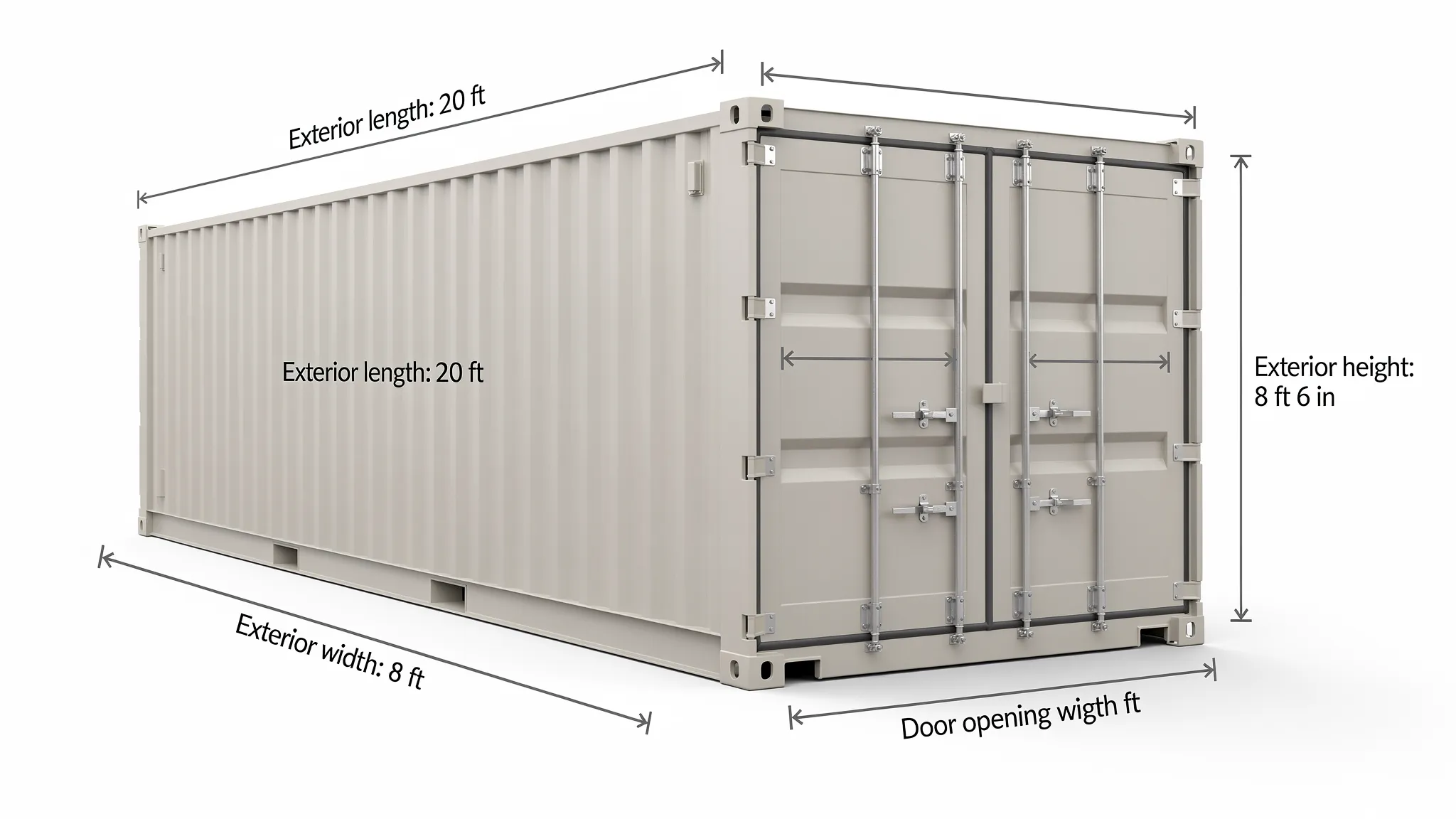
20ft sea container dimensions (exterior, interior, and doors)
A 20ft container is popular because it fits in many residential driveways and tighter job sites while still offering meaningful storage.
Exterior dimensions (why they matter)
Exterior dimensions determine whether the container will physically fit where you want it placed and whether delivery can access the site.
- Length: 20 ft
- Width: 8 ft
- Height: 8 ft 6 in (standard)
Practical planning tips:
- Allow extra space for door swing and access, not just the container footprint.
- If you’re placing next to fencing or a building, plan for airflow and drainage.
Interior dimensions (what you can actually store)
Interior dimensions matter most for shelving, equipment, pallets, and conversion layouts.
- Interior length: about 19 ft 4 in
- Interior width: about 7 ft 8 in
- Interior height: about 7 ft 10 in
The interior is smaller than the exterior because of corrugated walls and the floor structure.
Door opening size (a common surprise)
Even if something fits inside the container, it still has to fit through the door opening.
- Door opening width: about 7 ft 8 in
- Door opening height: about 7 ft 5 in
If you’re storing skid steers, mowers, motorcycles, or crated machinery, door clearance is often the limiting factor.
20ft sea container weight explained (tare, payload, and gross)
Container weight terms are confusing at first, but they matter for transport planning, crane or forklift selection, and safe loading.
The 3 weight numbers you should know
- Tare weight: the empty weight of the container.
- Payload: how much cargo weight the container can carry.
- Max gross weight: tare + payload combined.
Here are typical ranges for a standard 20ft dry container:
| Weight term | What it means | Typical value (approx.) |
|---|---|---|
| Tare weight | Empty container weight | ~4,800 to 5,300 lb |
| Max gross | Max allowed total weight | Up to ~67,200 lb |
| Payload | Max cargo weight inside | Up to ~62,000 lb |
Important: The tare weight varies by manufacturer and container build. Always check the container data plate for the exact tare on your unit if you’re planning shipping, heavy loading, or regulated transport.
Why weight matters for delivery and placement
A 20ft container is usually delivered on a tilt-bed or flatbed depending on access and offload needs. Even though the empty container is only around 5,000 lb, the truck, trailer, and turning radius requirements are often the bigger constraints.
If you plan to load the container heavily (tools, tile, paper goods, engine blocks, etc.), it can hit weight limits long before it looks “full.”
20ft sea container capacity (volume, pallets, and real-world fit)
Capacity can mean two different things:
- Cubic capacity (volume): how much space is inside.
- Load capacity (payload): how much weight it can safely carry.
Interior volume
A standard 20ft container is about:
- ~1,170 cubic feet of interior space
- ~33.2 cubic meters
This is why 20ft containers are a go-to for on-site storage, business inventory overflow, and small-to-mid conversion projects.
How many pallets fit in a 20ft container?
As a rule of thumb:
- A 20ft container fits about 10 standard U.S. pallets (48 in x 40 in) in a single layer.
Actual pallet count depends on:
- Pallet size (48×40 vs custom)
- Whether you need aisle space
- How you plan to load (forklift access, hand unload, mixed sizes)
Common use cases where 20ft is the “just right” size
A 20ft is often ideal when you need a serious storage footprint without the delivery complexity of a 40ft.
Typical uses include:
- Construction site tool and material storage
- Farm and ranch feed, tack, and equipment storage
- Small business inventory and document storage
- Secure storage at schools, churches, and municipalities
- Residential storage during remodels or moves
Standard vs High Cube 20ft containers (do you need extra height?)
Most 20ft containers in the U.S. are standard height (8 ft 6 in). 20ft high cube containers do exist in the market, but they’re less common than 40ft high cubes.
If your priority is extra headroom for shelving, tall equipment, or a conversion, many buyers simply choose:
- A standard 20ft (easier availability), or
- A 40ft high cube (best extra-height value in many markets)
If you’re unsure, tell us what you’re storing and where you’re placing it. We’ll help you choose the most practical option.
Container condition: what “cargo-worthy” and “wind & watertight” mean
Condition drives both performance and price. Two labels matter for most buyers:
Cargo-worthy
A cargo-worthy container is structurally fit for transport and heavy handling. It’s not “pretty,” but it’s built for real work.
Wind and watertight
A wind and watertight container is designed to keep the elements out for storage. Expect cosmetic wear on used units, but the container should keep rain out when properly closed.
Global Containers Line provides containers that are cargo-worthy, wind and watertight, and thoroughly inspected before dispatch.
If you’re buying for export, ask about documentation needs and whether you need a valid CSC plate for your use case. For background, see the IMO’s information on container safety and the CSC.
Pricing: what a 20ft sea container for sale costs (and what changes the number)
Buyers usually want a quick price, but the honest answer is that 20ft container pricing depends on a few variables that can move the total significantly, especially once delivery is included.
The biggest factors that affect price
- Condition grade: one-trip (newer) vs used (cargo-worthy or storage-grade)
- Your location and depot availability: pricing can differ across Texas, Florida, California, Arizona, and the Midwest
- Delivery distance and offload method: tilt-bed vs flatbed with customer-provided equipment
- Access constraints: tight turns, soft ground, steep slopes, limited clearance (can trigger re-delivery or special equipment)
How to get an accurate quote fast
To get a clean delivered number (no surprises), be ready with:
- Delivery ZIP code (or job site address)
- Any access restrictions (gates, narrow drives, overhead wires, soft ground)
- Preferred placement direction (which way the doors should face)
- Intended use (storage vs shipping vs conversion)
For a deeper breakdown of what’s included in delivered pricing, you can also read our guide on 20ft shipping container price factors.
Delivery: fast nationwide shipping across the USA
Global Containers Line coordinates fast nationwide delivery across the United States, including major markets like Houston, Dallas, Atlanta, Phoenix, Miami, Los Angeles, Orlando, Jacksonville, Tampa, and San Antonio, plus many surrounding towns and rural ZIP codes.
What delivery usually looks like
Most 20ft containers are delivered by:
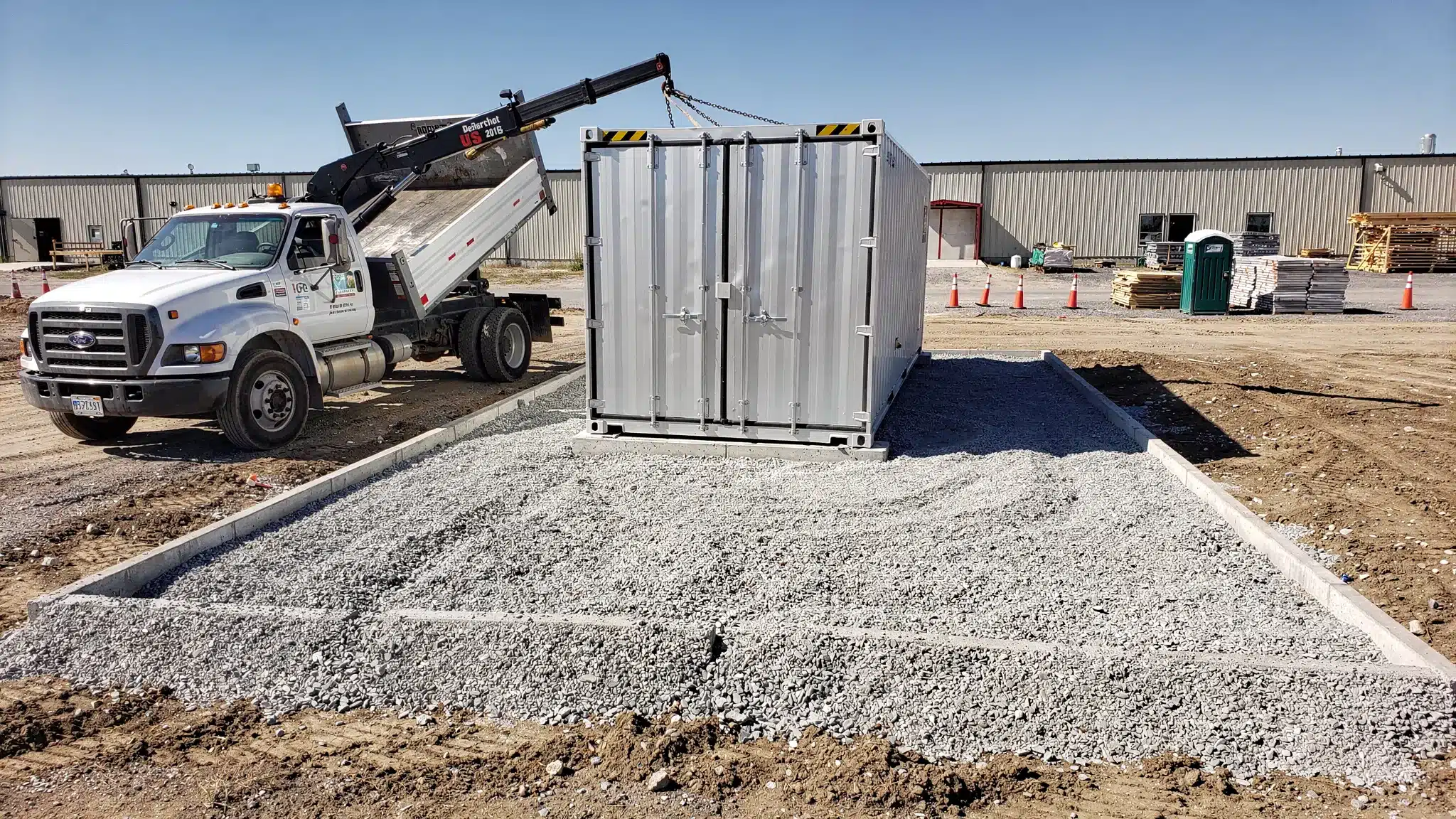
- Tilt-bed truck: common for residential and many job sites, the container slides off the back
- Flatbed/step-deck: used when site conditions require it or when offload equipment is available
Delivery success depends heavily on access. If you want to plan ahead, see our practical guide to transporting a shipping container (permits, costs, timelines).
Should you buy a 20ft or 40ft container?
A 20ft is easier to place and often the best choice when access is tight. A 40ft can deliver more cubic storage per delivery, if your site can handle the length.
Here’s a simple decision guide:
| Choose a 20ft container if you want | Choose a 40ft container if you want |
|---|---|
| Easier placement in tight areas | Maximum storage space per unit |
| A better fit for driveways and small yards | More room for shelving, workshops, or builds |
| A practical job-site tool container | A better choice for large inventory and equipment |
To browse inventory, start here:
- 20ft shipping containers
- 40ft shipping containers
Buying checklist: questions to ask before you order
Before you finalize a 20ft sea container for sale online, confirm these items with the supplier:
- What condition grade am I getting (one-trip, cargo-worthy, wind and watertight, refurbished)?
- Do you inspect containers before dispatch, and can you confirm doors and seals?
- Is the quote delivered to my ZIP code, and does it include all fees?
- What delivery method will be used, and what site access is required?
- What is the approximate tare weight for the unit being delivered (if weight matters for your project)?
- What should I check during delivery (roof, doors, floor, light leaks)?
If you’re comparing multiple offers, it also helps to read our guide on how to avoid hidden fees when buying shipping containers.
Frequently Asked Questions
What are the standard dimensions of a 20ft sea container? A standard 20ft container is typically 20 ft long x 8 ft wide x 8 ft 6 in tall on the outside. Interior dimensions are slightly smaller (about 19 ft 4 in long).
How much does a 20ft sea container weigh? A standard 20ft dry container usually has a tare (empty) weight around 4,800 to 5,300 lb. Exact tare varies by manufacturer, so check the container plate if you need precise numbers.
What is the maximum payload of a 20ft container? Many standard 20ft containers are rated for payloads up to roughly 62,000 lb, depending on the unit’s tare and max gross rating.
How many pallets fit in a 20ft container? In many real-world loading plans, a 20ft container fits about 10 standard U.S. pallets (48 in x 40 in) on the floor in a single layer. The exact number depends on pallet size and whether you need aisle space.
Are used 20ft containers watertight? They can be, but “used” alone doesn’t guarantee it. Look specifically for wind and watertight condition, and confirm doors, seals, and roof integrity. Global Containers Line containers are inspected and supplied as cargo-worthy and wind and watertight.
Do you deliver 20ft containers nationwide? Yes. We offer fast nationwide delivery across the United States, including major metros and many rural areas, with delivery planned around your site access.
Browse 20ft sea containers for sale (delivered to your location)
If you’re ready to buy from a trusted U.S. supplier, explore current availability or request a delivered quote.
- Browse: 20ft shipping containers
- Need more space? Browse: 40ft shipping containers
Prefer help choosing the right condition and delivery setup? Visit Global Containers Line to request pricing for your ZIP code and timeline.