
If you’re planning to buy 40ft container inventory for a job site, farm, warehouse overflow, or a container conversion, the biggest mistakes usually happen before money changes hands. Listings can look similar, “used” can mean very different things, and delivery details can add hundreds of dollars (or cause a failed drop-off).
This checklist is designed for U.S. buyers who want a clean, no-nonsense way to compare quotes and avoid surprises, whether you’re ordering in Houston, Dallas, Atlanta, Phoenix, Miami, Los Angeles, or a rural ZIP code.
Quick snapshot: the 10 questions that prevent most bad container buys
| Question to ask | What it protects you from | Why it matters on 40ft units |
|---|---|---|
| What grade/condition is it (one-trip, cargo-worthy, WWT, as-is)? | Paying “one-trip” money for a rough used box | 40ft containers vary more in wear due to age and handling cycles |
| What is the container being used for (storage, shipping, conversion)? | Buying the wrong grade or missing required paperwork | Export shipping can require CSC-related details |
| Is it wind and watertight, and what does that mean in writing? | Leaks, door seal problems, rust-through | Long spans on 40ft roofs can hide dents and pinholes |
| Do you have recent photos (or video) of the actual unit or same-grade stock? | “Stock photos” that don’t match reality | You want to see doors, roof, floor, and corners |
| What’s included in the price (delivered vs picked up)? | Hidden fees and surprise add-ons | 40ft delivery can be the biggest line item after the container |
| How will you deliver and offload it (tilt-bed, flatbed, crane)? | A failed delivery and re-delivery charges | 40ft offloads require more space and a better approach angle |
| What site access and clearance do you need from me? | Getting stuck on delivery day | Tight driveways and soft ground stop deliveries |
| Is the container inspected, and what’s the acceptance process at delivery? | Receiving a unit you wouldn’t have approved | You need a simple “inspect on arrival” plan |
| What payment methods do you accept, and is checkout secure? | Scam risk and charge disputes | High-dollar purchases attract bad actors |
| What’s the lead time and delivery window to my ZIP code? | Project delays | 40ft logistics can vary by region and availability |
1) “What condition grade is it, exactly?”
Before you buy, get the grade in plain language and make sure it matches your goal. Common terms you’ll see in the U.S. market include:
| Grade/condition term | Best for | What to expect |
|---|---|---|
| One-trip (new) | Clean storage, retail-facing projects, conversions where cosmetics matter | Minimal dents, cleaner floors, easier doors, higher cost |
| Cargo-worthy | Shipping use cases and rugged storage | Structurally sound, visible wear, repairs may be present |
| Wind and watertight (WWT) | Storage where appearance is not the priority | No active leaks, cosmetic rust and dents are normal |
| As-is | Low-cost projects where you can repair or accept defects | May have holes, bad floors, door issues, limited guarantees |
A good supplier will tell you what their grade means and what it does not mean. If a seller only says “used, good condition,” push for a real grade definition.
2) “Am I buying this 40ft container for storage, shipping, or a build?”
This sounds obvious, but it drives every other decision.
- Storage (jobsite, farm, small business): Many buyers choose used WWT or cargo-worthy, then spend a little extra on security.
- Shipping/export use: Ask about compliance expectations and documentation. The global standard behind container safety is the International Convention for Safe Containers (CSC). You can read the background at the International Maritime Organization (IMO).
- Conversions (office, home, storefront): Door operation, floor condition, and straight walls matter more because modifications amplify existing problems.
If you’re not sure whether a 40ft is right (versus two 20fts), compare availability and placement options. You can also browse both sizes to see what fits your site and budget: 20ft shipping containers for sale and 40ft shipping containers for sale.
3) “Is it wind and watertight, and what does that mean in your terms?”
“Wind and watertight” should mean the container keeps out wind and rain under normal conditions. But different sellers use the phrase loosely.
Ask for confirmation that covers the common leak points:
- Door gaskets and sealing surfaces
- Roof (especially for dents that hold water)
- Side panels near the top rail
- Floor integrity (no soft spots, severe rot, or delamination)
If the seller can’t describe how they evaluate watertightness, treat it as a red flag.
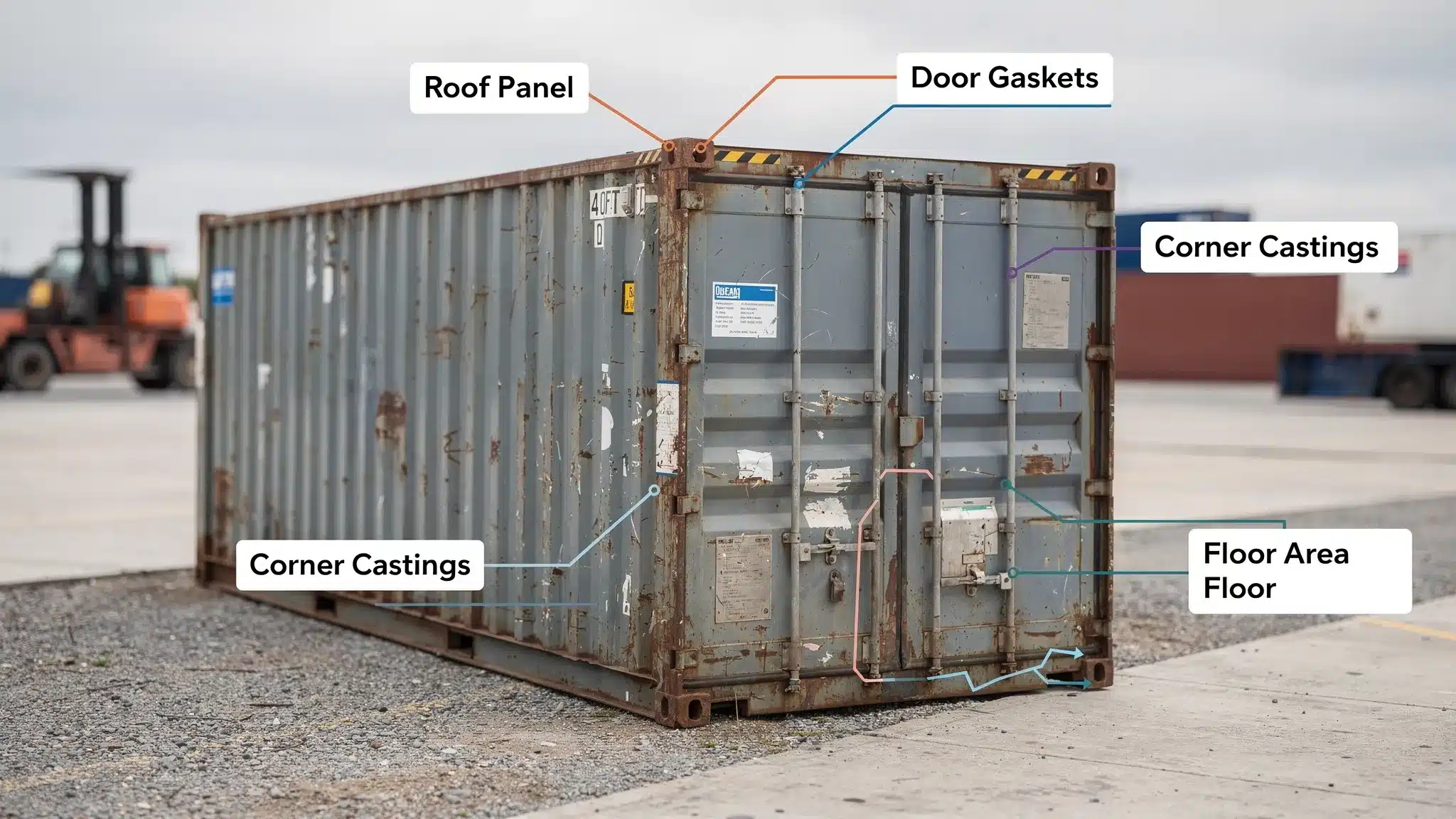
4) “Can you provide recent photos (or video), and are they of the actual unit?”
If you’re buying online, photos are your best substitute for an in-person inspection. Ask for recent images of:
- Both doors open and closed
- Door seals and locking bars
- Roof line (side angle helps reveal dents)
- Interior floor (especially corners and near the doors)
- Corner castings and the general side profile
If the seller uses stock photos, ask for “same-grade, same-depot” photos at minimum, plus a clear written condition description.
5) “Is this price delivered to my site, or is delivery extra?”
Many pricing headaches come from comparing a pickup price to a delivered price. A clean quote should separate:
| Quote line item | What to confirm |
|---|---|
| Container unit price | Size (40ft standard vs 40ft high cube), grade, doors type |
| Delivery/trucking | Your ZIP code, distance from depot, fuel/route constraints |
| Offload method | Tilt-bed included or crane/flatbed requirements |
| Taxes/processing | Any applicable taxes and card/processing fees |
If you’re getting quotes in different metros like Dallas vs. Phoenix (or Miami vs. Atlanta), delivered pricing can vary due to depot distance and trucking availability, even if the container itself is similar.
6) “How will you deliver and offload a 40ft container at my address?”
40ft containers are commonly delivered by:
- Tilt-bed: Often the simplest for job sites and homes, but it needs room to tilt and slide.
- Flatbed/step-deck: Requires a separate offload plan (forklift of sufficient capacity, crane, or specialized equipment).
Ask the supplier what they typically use in your area and what you need to provide.
Practical note: If you’re in tight-access neighborhoods (common in parts of Los Angeles or older sections of Miami) or you have narrow gates and trees, delivery method becomes the decision-maker.
7) “What site access and clearances do you need from me (and what happens if the truck can’t access)?”
A reputable supplier will ask about access before dispatch. Be ready to share:
- Delivery address and ZIP code
- Driveway width and turning space
- Overhead obstacles (power lines, tree limbs)
- Ground conditions (mud, soft soil, steep grade)
- Where you want the doors facing
Also ask what the policy is if delivery cannot be completed due to access. This is one of the most common sources of unexpected costs in container purchases.
8) “Is the container inspected before dispatch, and what is my acceptance process?”
You want two things here:
- Pre-dispatch inspection (to reduce surprises)
- A simple on-delivery inspection checklist so you can accept confidently
On delivery day, do a fast walkaround before the driver leaves:
- Open and close both doors (they should seal and lock reasonably)
- Look for light coming through the roof or walls from inside
- Check the floor near the doors and corners
- Confirm the container sits level and looks straight (no twisted frame)
Global Containers Line notes that containers are thoroughly inspected before dispatch and supplied as cargo-worthy, wind and watertight units, which is exactly what you should be looking for when buying online.
9) “What payment methods do you accept, and is checkout secure?”
This question is about risk control.
If a seller pressures you into wire-only payments, won’t provide an invoice, or won’t confirm business details, walk away. For most buyers, a secure checkout and transparent paperwork reduces fraud risk and makes accounting easier.
Global Containers Line emphasizes secure online ordering and transparent pricing (no hidden fees), which are two signals you want in a supplier, especially when you’re purchasing remotely.
10) “What’s the lead time to my ZIP code, and do you offer nationwide delivery?”
For planning a project, you need two timelines:
- Availability timeline: Is the 40ft container in stock now, or coming in?
- Delivery timeline: How soon can trucking deliver once it’s ready?
Ask for the delivery window in writing and confirm whether scheduling is affected by site access, weather, or local trucking capacity.
Global Containers Line offers fast nationwide delivery across the United States, serving major markets like Houston, Dallas, Atlanta, Phoenix, and Miami, as well as many other cities and surrounding areas.
A simple decision rule before you pay
If you’re comparing offers, use this rule:
A “good deal” is the quote that best matches your intended use, includes delivery and offload reality for your site, and clearly defines the grade and acceptance process.
The cheapest sticker price is often not the cheapest delivered outcome.
Frequently Asked Questions
What’s the best condition to buy if I want a 40ft container for storage? Most storage buyers choose wind and watertight or cargo-worthy, then add security (like a lockbox) if needed. If appearance matters, consider one-trip.
How much does it cost to buy a 40ft container in the USA? Pricing varies by condition, location, and delivery. The fastest way to get an accurate number is to request an itemized delivered quote using your ZIP code and site details.
Do I need a permit to place a 40ft container on my property? Sometimes. Rules vary by city and county, and may depend on duration, zoning, and whether you modify the container. Always check local requirements before delivery.
Can a 40ft container be delivered to a residential driveway? Often yes, if there’s enough turning radius, overhead clearance, and solid ground. Tight access is common, so share photos and measurements with your supplier before dispatch.
What should I inspect first on a used 40ft container? Start with the doors (operation and seals), roof (dents and pinholes), and floor (soft spots). Those issues are the most expensive and disruptive later.
Browse 40ft containers or request a delivered quote
If you’re ready to buy 40ft container inventory with clear condition standards and delivery you can count on, browse current availability or request a delivered quote from a trusted U.S. supplier.
- Shop: 40ft shipping containers for sale
- Compare sizes: 20ft shipping containers for sale
Global Containers Line provides new and used containers, transparent pricing, and fast nationwide delivery across the United States so you can order with confidence and keep your project on schedule.