
Buying used cargo containers for sale can be a smart way to cut costs for storage, construction, or even a container conversion. The trade-off is simple: used inventory varies a lot. Two containers can look similar in photos and perform very differently on your site.
This buyer checklist breaks down what to inspect (and what to ask) so you can avoid leaks, door issues, soft floors, and expensive surprises, whether you’re buying in Texas, Florida, Georgia, Arizona, California, or anywhere else in the U.S.
Quick reality check: What “used” usually means (and what it doesn’t)
Used shipping containers are built for harsh conditions. Cosmetic dents, surface rust, and mismatched paint are normal. What matters is whether the unit is structurally sound and matches your use case.
Common condition labels you’ll see:
- Cargo-worthy: Structurally suitable for transport and stacking (often associated with export/shipping needs). Cosmetic wear is expected.
- Wind and watertight (WWT): Intended to keep out wind and water for storage, but not necessarily suitable for ocean export.
- As-is: Cheapest, highest risk. Expect repairs.
- One-trip (new): Minimal wear and typically the cleanest option.
If you are unsure which grade fits your job, the site’s broader buying guidance can help you compare options: Ultimate Shipping Container Buying Guide.
Before you inspect: 7 questions to ask the seller (saves the most time)
A good inspection starts before you ever drive to a yard.
Confirm the basics in writing
Ask the seller to confirm:
- The exact condition grade (cargo-worthy vs WWT vs as-is)
- The size (20ft, 40ft, 40ft high cube) and door configuration
- Whether the container is wind and watertight (if that’s promised)
- Whether it is cargo-worthy (if you plan to ship cargo)
- The delivered price to your ZIP code (not just a yard price)
- The delivery method (tilt-bed, flatbed, chassis) and what your site must provide
- What happens if the unit delivered does not match the agreed condition
Request specific, recent photos
Generic stock photos are not inspection. Ask for photos of the actual unit or a unit from the same lot that represents the same grade.
| Photo you should request | What it helps you catch fast |
|---|---|
| Door seals close-up | Missing seals, gaps, light leaks |
| Door handles and locking cams | Bent hardware, hard-to-open doors |
| Roof (at least 2 angles) | Patches, pinholes, pooling damage |
| Corner castings | Twist, heavy impacts, lifting damage |
| Floor close-up | Soft spots, delamination, staining |
| Interior corners and ceiling | Water intrusion, mold, daylight |
| Container ID and CSC plate (if applicable) | Documentation, export suitability |
If the seller refuses recent photos, or pushes you to “just trust the grade,” treat that as a red flag.
Used cargo container inspection checklist (step-by-step)
Plan for 15 to 25 minutes if you’re inspecting in person. If you’re buying online, use the same checklist for your delivery-day inspection.
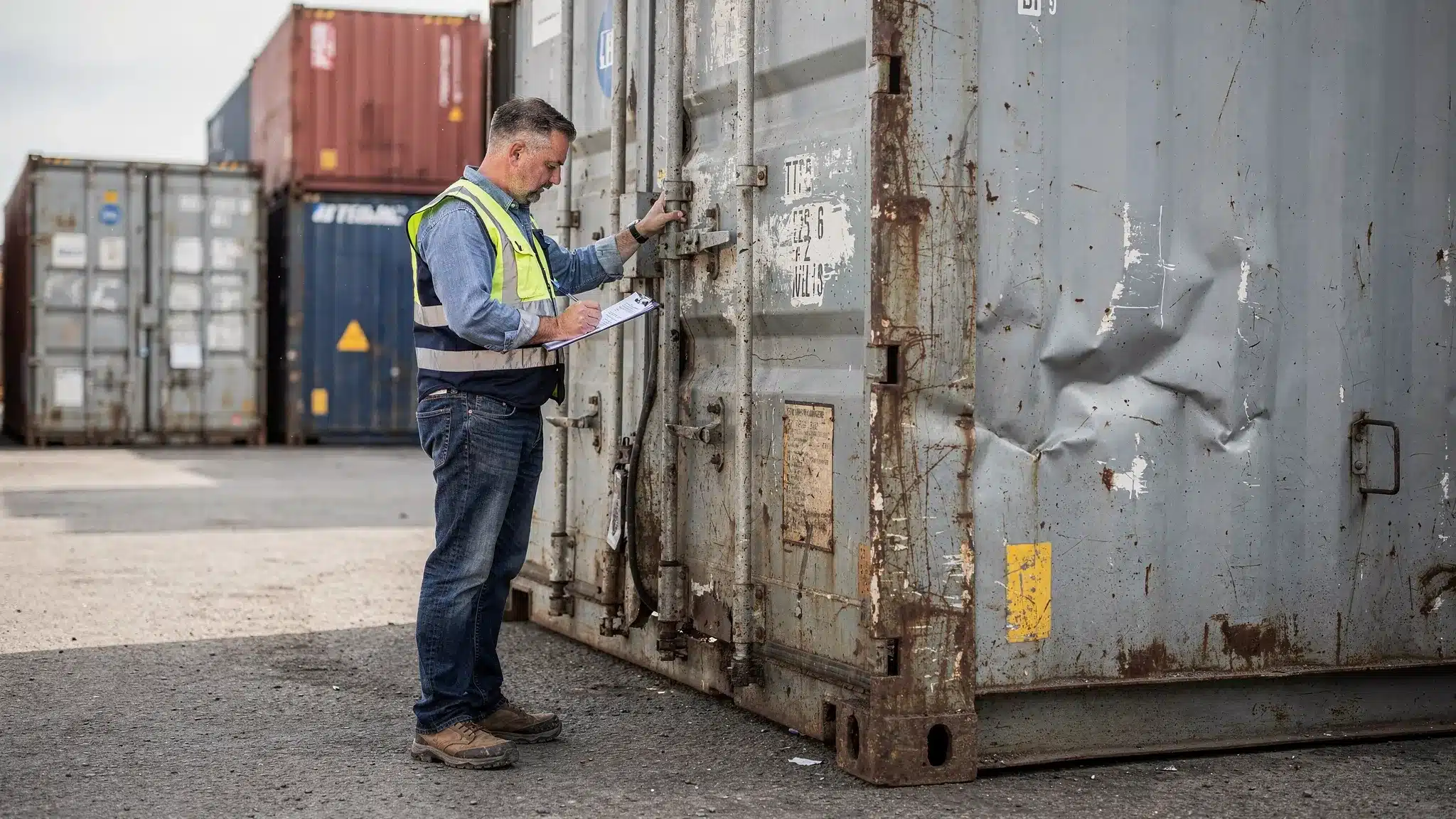
1) Exterior: frame, walls, and roof (structural integrity)
Start with a slow walk around the container.
What to look for on the exterior:
- Roof condition: The roof is one of the most important leak points. Avoid roofs with multiple patches, deep dents, or obvious pinholes.
- Sidewalls and end walls: Dents are common, but watch for long creases and impacts that look like they changed the container’s shape.
- Corner posts and corner castings: These are critical for lifting and stacking. Heavy damage here can indicate structural problems.
- Under-rail and base frame: Look for heavy corrosion, bent rails, or damage that suggests the container was dragged.
Simple test: Stand inside with doors closed on a bright day and look for daylight through the roof or upper corners. Daylight often means a leak path.
2) Doors: hinges, seals, and locking hardware (the most common buyer complaint)
Doors tell you a lot about how the container was treated.
Door checks that matter:
- Doors should open and close without extreme force.
- Locking cams should rotate smoothly and align with the keepers.
- Gaskets/seals should be present and reasonably intact.
- Door alignment should look square (not sagging).
Red flags:
- You must lift the door to close it (hinge wear, frame twist)
- Visible gaps along the seal line
- Broken cam keepers or missing hardware
3) Interior: floor condition, odors, and contamination risk
Most used containers have plywood floors that are durable but not indestructible.
Floor inspection checklist:
- Walk the entire floor and feel for soft spots.
- Look for delamination, deep gouges, or black staining.
- Check the rear corners (near doors) where water intrusion shows up first.
Odor check (important for certain uses):
- Mild “industrial” smell is common.
- Strong chemical odors can be a deal-breaker if you plan to store household goods, textiles, paper, or food-adjacent items.
If you’re using the container for business inventory, tools, or farming supplies, odor and floor integrity matter as much as exterior paint.
4) Water tightness: quick leak checks you can do anywhere
You do not need a full hose test to get useful information.
Fast leak indicators:
- Rust trails down interior walls
- Damp corners or discoloration near the roof seams
- Daylight through pinholes
- Bubbling paint and flaking rust on the roof
If you can hose test (or the yard can), focus water around:
- Door perimeter
- Roof seams
- Any patched areas
5) Rust: understand what’s normal vs. what’s expensive
Some rust is expected on used cargo containers for sale. The key is how deep it goes.
| Rust type | Usually acceptable? | Why it matters |
|---|---|---|
| Surface rust (orange, no pitting) | Often yes | Cosmetic, can be treated |
| Moderate pitting | Maybe | Can shorten life if widespread |
| Holes, flaking steel, heavy scaling | Usually no | Structural and water intrusion risk |
If you’re buying in coastal or humid areas (Miami, Tampa, Jacksonville, Houston), be extra strict on roof rust and door seals.
6) Repairs and patches: not always bad, but verify quality
Used containers are commonly repaired. The problem is sloppy repairs.
Good repair signs:
- Patch plate is welded cleanly
- No sharp edges or open seams
- Patch location makes sense (small impact repair)
Bad repair signs:
- Multiple roof patches across large areas
- Riveted patches with gaps
- Patch over obvious rust-through without proper prep
7) Documentation: CSC plates and “cargo-worthy” expectations
If your container is intended for cargo transport, ask about the CSC plate and any documentation tied to the container’s suitability.
For background, the CSC system comes from the International Convention for Safe Containers (administered through maritime regulators). You can reference the concept via the International Maritime Organization (IMO).
Important note: many buyers confuse “cargo-worthy” with “like new.” Cargo-worthy is about structural fitness, not cosmetics.
The 10-minute delivery-day inspection (for online orders)
If you buy used containers online, plan to inspect the unit immediately on delivery (before the driver leaves, if possible).
Use this quick sequence:
- Check the container number matches paperwork (if provided).
- Open and close doors fully, confirm seals contact evenly.
- Look at the roof from the ground (or a safe vantage point) for obvious holes and bad patches.
- Step inside, close doors, check for daylight.
- Walk the floor, especially near the doors and corners.
- Confirm the container sits level on your blocks or base (a twist can cause door problems).
If anything is off, document it with clear photos right away.
Pricing: what affects the cost of used cargo containers for sale
Used container pricing is not one national number. It varies by:
- Size (20ft vs 40ft)
- Condition grade (WWT vs cargo-worthy vs one-trip)
- Your city/state and proximity to depots
- Delivery distance and offload method
- Seasonality (construction peaks can tighten inventory)
To see realistic examples by market, you can compare city guides such as Houston, Orlando, Phoenix, and Los Angeles across the site (each shows how condition and delivery affect totals).
Budget for the delivered total, not just the container
A transparent quote should separate the main components.
| Cost component | What it covers | Why buyers miss it |
|---|---|---|
| Container unit price | The container itself | Yard price looks “cheap” |
| Delivery/trucking | Transport to your site | Often quoted separately |
| Offload method | Tilt-bed, crane, chassis, etc. | Site limits drive cost |
| Add-ons | Lockbox, vents, minor upgrades | Optional but common |
If you want a deeper breakdown of common surprises, this guide is helpful: Shipping Containers for Sale: How to Avoid Hidden Fees.
Delivery planning checklist (to avoid failed delivery and extra charges)
Nationwide delivery is convenient, but only if the site is ready.
Key site requirements to confirm
- Clear access width for the truck route and turns
- Overhead clearance (trees, wires, roofs)
- A firm, level drop area (gravel, compacted base, concrete)
- Space to position the container with doors facing the direction you want
If you’re in tighter urban areas (Los Angeles, Miami, Atlanta) or have narrow rural access (farm roads outside Dallas or Phoenix), share photos of the approach and the drop zone when requesting a quote.
For delivery logistics in more detail, see: Transporting a Shipping Container: Permits, Costs, Timelines.
Should you buy a used 20ft or 40ft cargo container?
It depends on how you’ll use it and what your site can handle.
20ft containers (common for tight sites)
A 20ft is often easier to place in driveways, smaller job sites, and tighter yards. It’s a popular choice for tools, equipment, and small business storage.
Browse available options here: 20ft shipping containers for sale.
40ft containers (best value per square foot)
A 40ft is usually the better deal for larger storage needs, farm operations, and construction staging. It also gives more room for organization and aisle space.
Browse available options here: 40ft shipping containers for sale.
If you’re not sure, consider how often you’ll access items. Many buyers outgrow “just enough space” quickly.
Why buyers choose Global Containers Line for used containers
When you’re shopping for used cargo containers for sale near you, the biggest risk is getting a unit that does not match the description.
Global Containers Line is a USA-based supplier of new and used shipping containers, known for:
- Cargo-worthy and wind-and-watertight used containers
- Thorough inspection before dispatch
- Transparent pricing and secure online ordering
- Fast nationwide delivery across the United States, including major markets like Houston, Dallas, Atlanta, Phoenix, and Miami
Frequently Asked Questions
What should I inspect first on used cargo containers for sale? Start with the roof, doors, and floor. Those three areas drive most leak problems, security issues, and repair costs.
Is surface rust okay on a used shipping container? Yes, surface rust is common and usually cosmetic. Avoid rust-through (holes), heavy scaling, or widespread deep pitting, especially on the roof and door frame.
How do I check if a used container is really wind and watertight? Do the daylight test (stand inside with doors closed and look for light), inspect door seals, and look for rust trails or stains inside. If possible, hose test around the doors and roof seams.
Do I need a cargo-worthy container for storage? Not always. For storage, many buyers choose wind-and-watertight containers. Cargo-worthy matters more if you plan to ship cargo or need stronger assurance of structural suitability.
How long does delivery take for a used container in the USA? Delivery timing depends on inventory location and trucking schedules. The fastest way to get an accurate timeline is to request a delivered quote with your ZIP code and site details.
Browse used inventory or request a delivered quote
Ready to buy with confidence? Browse available containers or request a quote based on your ZIP code and delivery access.
Global Containers Line offers fast nationwide delivery across the United States with inspected inventory and clear, upfront pricing.
- Browse: 20ft shipping containers for sale and 40ft shipping containers for sale
- Get help choosing the right grade and delivery plan: visit Global Containers Line to request pricing and availability