
Buying storage containers for sale sounds simple until you have to pick a size. Order too small and you end up stacking, struggling with access, or renting a second unit. Go too big and you pay more for steel and delivery than your project needs.
This guide breaks down the most common container sizes (10ft, 20ft, and 40ft, including High Cube options), how to estimate your space, what “cargo-worthy” and “wind and watertight” really mean, and what to expect for pricing and delivery across the United States.
Quick answer: which storage container size fits your project?
If you want a fast, practical match, start here:
| Your project | Best starting size | Why it works |
|---|---|---|
| Jobsite tool storage, small business backstock, campus maintenance | 10ft or 20ft | Easy to place, lower delivered cost, simpler access |
| Household storage during renovation or move | 20ft | Balanced capacity without overbuying footprint |
| Farm equipment, pallets, inventory overflow, light workshops | 40ft | More linear space for shelving and walkways |
| Container home or large conversion with insulation and framing | 40ft High Cube | Extra height helps once you add floors, walls, and utilities |
| Two-person access, frequent in and out, staging areas | 40ft | More room for aisles and “grab-and-go” organization |
If you are still on the fence between 20ft and 40ft, jump to 20ft vs 40ft: what usually decides it.
Common storage container sizes (and what they’re best for)
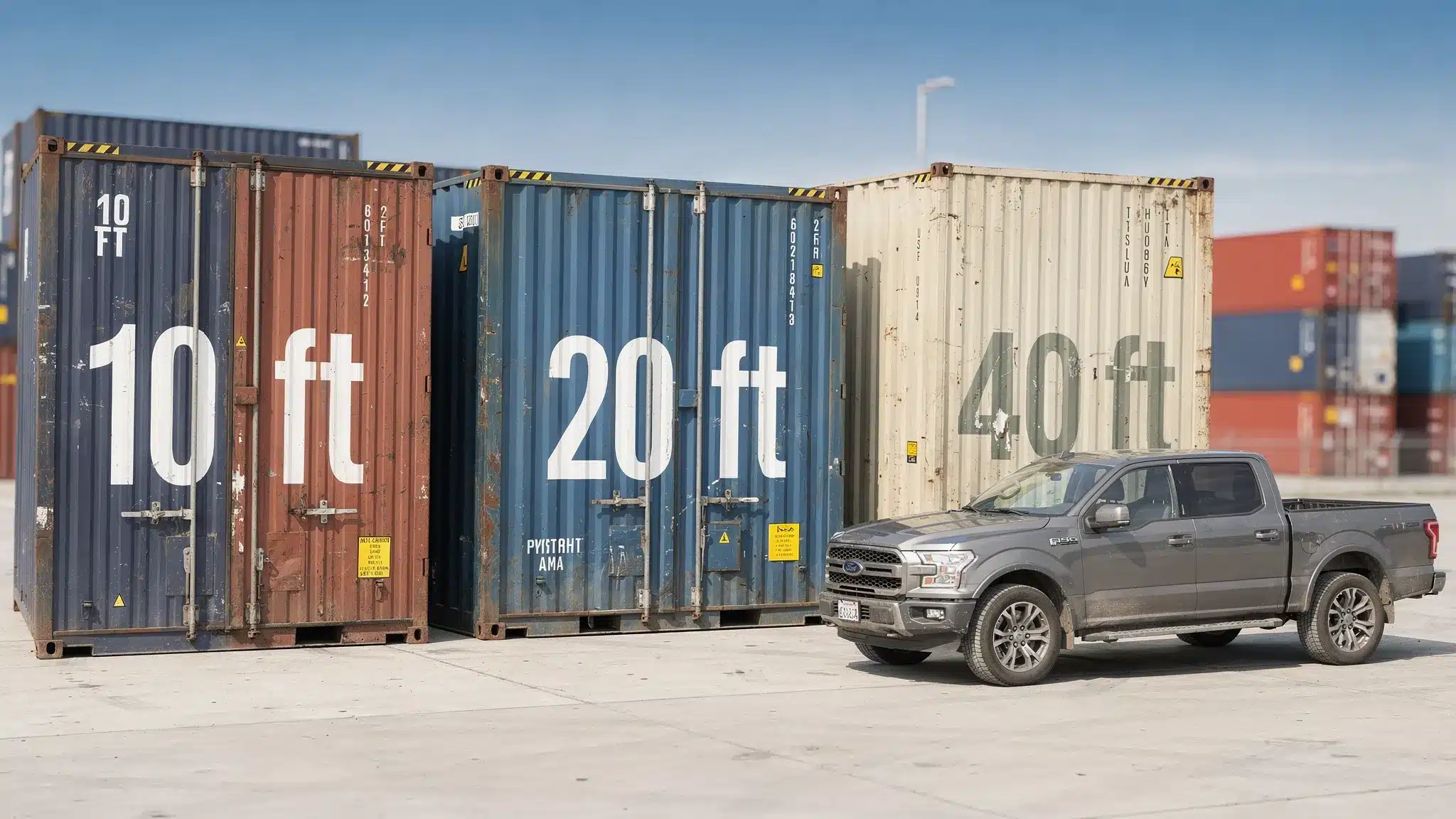
Most buyers in the U.S. choose between 10ft, 20ft, and 40ft containers. These are ISO shipping containers, designed to be durable, stackable, and forklift and crane friendly.
10ft storage containers
A 10ft container is the “small footprint” option for tight sites.
Good fit for:
- Tight urban lots (for example, parts of Los Angeles, Miami, or downtown Houston)
- Schools, municipalities, and maintenance teams
- Tools, lawn equipment, seasonal inventory, document storage
Watch-outs: You can fill a 10ft faster than you expect, especially once you add shelving.
20ft storage containers
A 20ft is the most popular “all-around” size because it balances capacity, placement flexibility, and delivered cost.
Good fit for:
- Construction sites in Dallas, Atlanta, Phoenix, and other fast-growing metros
- Home renovations and temporary storage
- Small business inventory, e-commerce overflow, or light equipment storage
If you are shopping this size now, browse our inventory of 20ft shipping containers for sale with fast nationwide delivery.
40ft storage containers
A 40ft container is ideal when you need real linear space, organized storage, and walking room.
Good fit for:
- Pallet storage (multiple rows with aisles)
- Farm and ranch storage (feed, fencing, tools, equipment)
- Contractors staging materials (drywall, flooring, fixtures)
- Retail and warehouse overflow
If you want maximum space per delivered unit, check available 40ft shipping containers.
High Cube (extra height) options
High Cube containers are typically about 1 foot taller than standard height. That extra height matters more than most people expect, especially for:
- Shelving and tall items
- Conversion projects with insulation, framing, and electrical runs
- Better “feel” and ventilation when used as a workshop
A simple way to estimate the right container size
Before you compare listings, do a quick space estimate. You do not need perfect math, you need a realistic buffer.
Step 1: List what you’re storing (and how you access it)
Two buyers can store the same amount of “stuff” but need different space.
- If you will “set it and forget it” (seasonal items), you can pack tighter.
- If you need weekly access, plan for aisles, shelves, and door clearance.
Step 2: Decide how you’ll organize it
Your storage plan affects the container size as much as the volume.
- Floor stacking is space efficient but makes access harder.
- Shelving improves access but increases the space you need.
Step 3: Build in a buffer
As a rule of thumb, add extra room for:
- Walkway space
- Future inventory growth
- Pallet jack maneuvering (if applicable)
A 20ft often works when you need secure storage but can keep items organized with a single aisle. A 40ft makes sense when you need multiple “zones” (tools, materials, inventory, returns, seasonal).
20ft vs 40ft: what usually decides it
Most “what size should I buy?” decisions come down to four practical factors.
1) Your site access and delivery constraints
Delivery is often the hidden deciding factor, especially in dense areas like Los Angeles, Miami, and parts of Atlanta.
Consider:
- Gate width and turning radius
- Overhead obstacles (trees, wires)
- Surface conditions (soft ground, slope)
- Where the truck will offload
A 40ft needs more room to maneuver. If your driveway or jobsite is tight, a 20ft can be the difference between a smooth drop and a reschedule.
2) How often you need to get items in and out
If the container is basically a secure “warehouse aisle,” space pays for itself.
- Frequent access favors 40ft because you can keep items organized.
- Infrequent access often favors 20ft or even 10ft.
3) What you’re storing (bulky vs heavy vs long)
- Long materials (lumber, piping) push you toward 40ft.
- Dense, heavy items (tools, parts) may fit in a 20ft, but verify you can load safely and place the unit on a stable base.
4) Your total delivered cost, not just the container price
A larger unit costs more and can cost more to deliver, but it can be cheaper than buying two smaller containers and paying two deliveries.
If you are unsure, tell us what you are storing and your ZIP code and we can recommend a size that fits your project and site.
Container condition: what “cargo-worthy” and “wind and watertight” mean for storage
When you search storage containers for sale, you will see condition terms that affect both price and performance.
New (often called “one-trip”)
New containers are typically used once for shipping, then sold. They are a strong choice when appearance matters or when you want the most predictable door operation, flooring condition, and paint.
Used containers (storage-grade options)
Used containers are popular for job sites, farms, and businesses because they are cost-effective and still highly durable.
Cosmetic wear is normal, especially on used units, but good storage containers should still protect your contents.
Cargo-worthy and wind and watertight (WWT)
At Global Containers Line, containers are thoroughly inspected before dispatch and are cargo-worthy and wind and watertight, meaning they are suitable for secure storage and can hold up to typical weather exposure.
For storage buyers, prioritize:
- Doors that open and seal properly
- Solid floors
- Roof and side walls without active leaks
- Frames and corner castings in good shape for handling
If you are planning a conversion (office, home, retail), ask about the best condition for cutting openings and finishing interiors. The cheapest unit is not always the lowest risk once you start modifying.
Pricing: what affects the cost of storage containers for sale
Container pricing changes by region and timing, so it is better to understand what drives your delivered quote than to chase a single national number.
The biggest pricing factors
- Size: 40ft typically costs more than 20ft, and High Cube typically adds a premium.
- Condition: new usually costs more than used.
- Availability near your location: pricing can differ between port markets and inland markets.
- Delivery distance and offload method: access challenges can add cost.
- Optional add-ons: lock boxes, vents, shelving, paint, modifications.
The most useful pricing question to ask
When comparing suppliers, ask for the delivered price to your site, not just the container price.
A complete quote should clarify:
- Container size and condition
- Delivery included or quoted separately
- Offload method assumptions (for example, tilt-bed versus crane)
- Any access surcharges (tight roads, steep grades, limited staging)
If you want city-specific examples, we publish local guides for major markets, but the fastest way to get accurate numbers is to request a delivered quote for your ZIP code.
Delivery: what to expect across the United States
Global Containers Line offers fast nationwide delivery across the United States, including major cities like Houston, Dallas, Atlanta, Phoenix, Miami, and many surrounding towns and rural areas.
Typical delivery timeline (what affects it)
Delivery timing depends on inventory availability, distance, scheduling, and site readiness. In practice, the two biggest delays are:
- Not enough space for the truck to maneuver and offload
- Unclear drop instructions (door direction, exact placement location)
Basic delivery readiness checklist
Before your delivery day, confirm:
- The drop area is level and firm (gravel or compacted base is common)
- You have overhead clearance for the truck and container
- You have enough straight-line space for offload
- You know where you want the container doors to face
If your site is tight, tell your supplier early. It is often easier to choose a 20ft or adjust the drop plan than to force a 40ft into a constrained space.
Real-world size matches (common U.S. buyer scenarios)
Construction contractor in Dallas or Houston
If you need secure jobsite storage for tools and materials, a 20ft is often the best balance. It stores a lot, places easily, and is simpler to relocate as projects change.
Small business inventory in Atlanta
If you are receiving pallets or need organized picking and staging, a 40ft is usually the better long-term choice, especially if you want shelving with a walkway.
Farm storage outside Phoenix
For mixed items like equipment, feed, and seasonal supplies, a 40ft gives you zones and access, so you are not unloading half the container to reach one item.
Home renovation in Miami or Los Angeles
If you have limited driveway space or HOA constraints, a 20ft (or 10ft) can be the practical option. The right size is the one you can actually place where you need it.
Buying storage containers online without surprises
A good online purchase should feel straightforward, not risky. Look for:
- Clear container condition standards
- Real support when you have delivery questions
- Transparent pricing and secure checkout
- A supplier that coordinates logistics, not one that leaves you to find trucking
If you have a team handling inbound calls or quoting, consistent communication matters. Some companies use AI-based roleplay training to help staff handle pricing and delivery objections more professionally, tools like AI sales and service roleplay training can be useful for improving quote conversations and customer experience.
Frequently Asked Questions
What size storage container should I buy for a typical household? Most household storage needs fit well in a 20ft container, especially if you pack efficiently and do not need wide aisles. If you want shelving and easy access, a 40ft can be worth it.
Are used storage containers still watertight? Many used containers are excellent for storage, but you should confirm the unit is wind and watertight and has been inspected. Cosmetic dents and paint wear are normal and usually do not affect performance.
How much do storage containers for sale cost delivered? Delivered cost depends on size, condition, and delivery details (distance, site access, and offload method). The best approach is to request a delivered quote for your ZIP code so you can compare apples to apples.
Do you deliver nationwide in the USA? Yes. Global Containers Line provides fast nationwide delivery across the United States, including major metros and many surrounding areas.
What do I need to prepare for delivery? You typically need a firm, level area, enough truck access for offloading, overhead clearance, and a plan for door orientation. If access is tight, discuss it before ordering so the delivery method matches your site.
Get the right-size container delivered to your location
If you are ready to buy, start with the size that matches your project, then confirm condition and delivery access. Global Containers Line is a trusted U.S. supplier of new and used containers, with inspected, cargo-worthy units, transparent pricing, secure online ordering, and fast nationwide delivery.
Browse available inventory:
Prefer a fast answer? Request a delivered quote with your ZIP code and a quick description of what you plan to store.