
On site storage solutions help keep tools, materials, inventory, and equipment close to the work area without the cost or delay of building permanent storage. For contractors, farms, warehouses, retailers, real estate developers, and homeowners, shipping containers offer a practical way to add secure space directly where it is needed.
A steel shipping container can be delivered to a construction site in Dallas, a farm in Georgia, a warehouse yard in Houston, a residential property in Phoenix, or a commercial lot in Miami. Once placed, it becomes a durable storage unit that can support daily operations, seasonal needs, or long-term property organization.
Global Containers Line supplies new and used shipping containers for sale across the USA, with fast nationwide delivery, transparent pricing, secure online ordering, and inspected container options for storage, construction, commercial, and residential use.
What Are On Site Storage Solutions?
On site storage solutions are storage systems placed directly at your jobsite, business location, farm, home, or project property. Instead of hauling materials back and forth from an off-site warehouse, you keep supplies close to where they are used.
For many U.S. buyers, shipping containers are one of the most reliable on site storage solutions because they are made from heavy-duty steel, designed for transportation, and built to withstand outdoor conditions. They can store construction tools, building materials, landscaping equipment, retail overflow, farm supplies, household goods, and more.
The main advantage is simple: your storage is where your work happens. That saves time, reduces unnecessary trips, and helps protect valuable items from theft, rain, wind, and unauthorized access.
Why Shipping Containers Work Well for On Site Storage
Shipping containers are popular for on site storage because they combine security, durability, mobility, and flexibility in one structure. Unlike temporary sheds or open trailers, containers are enclosed steel units with strong doors and a weather-resistant design.
Strong protection for tools, materials, and inventory
A shipping container gives you a secure place to store valuable items after hours. Contractors can lock up power tools, generators, lumber, electrical supplies, and plumbing materials. Businesses can store overflow inventory, seasonal displays, files, or equipment. Homeowners can protect furniture, renovation supplies, and outdoor gear during a remodel.
Security can be improved further with quality locks, lockboxes, lighting near the container, and smart placement on the property. For high-value contents, many buyers also position the doors where they are visible from an office, camera, or main access point.
Weather-resistant storage without permanent construction
Most storage containers used for on site storage are wind and watertight, meaning they are built to keep out normal rain and wind when the doors, seals, roof, and walls are in good condition. This makes them a strong option for outdoor storage in cities and states with changing weather, from Florida humidity to Texas storms and Arizona heat.
For items sensitive to moisture, add simple moisture-control steps such as pallets, desiccants, vents, or a dehumidifier where power is available. These small adjustments can help reduce condensation and keep stored goods better protected.
Flexible space that can move with your project
A container can serve one location for months or years, then be moved or resold when your needs change. This flexibility is useful for construction companies moving between projects, farms managing seasonal supplies, and small businesses expanding storage without committing to a new building lease.
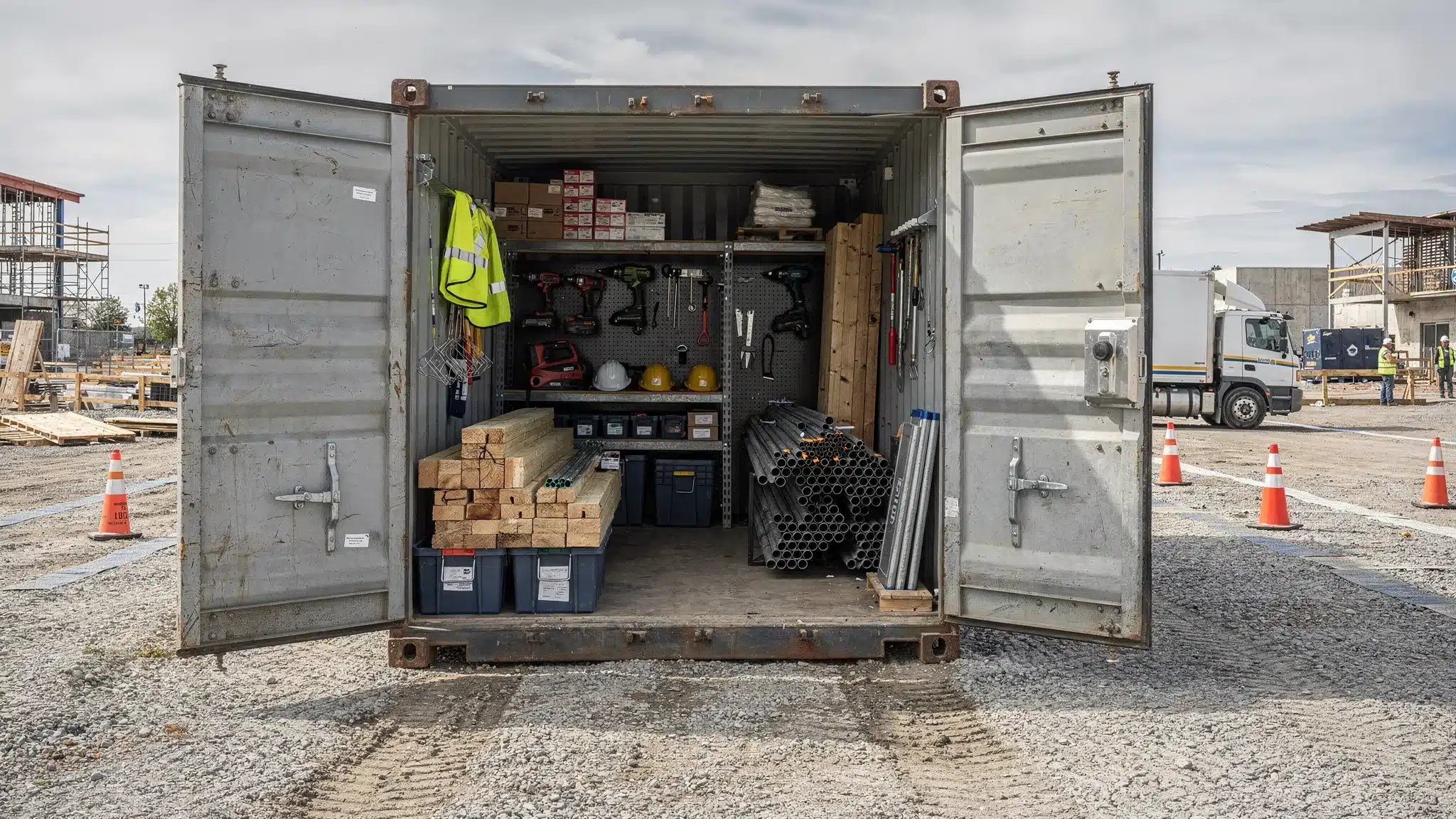
Common On Site Storage Uses for Shipping Containers
Shipping containers work across many industries because the basic need is the same: secure, accessible, weather-resistant storage near the point of use.
| Buyer type | Common storage need | Container option to consider |
|---|---|---|
| Construction companies | Tools, equipment, lumber, jobsite materials, safety gear | 20ft or 40ft container depending on site size |
| Logistics and warehouse businesses | Overflow inventory, pallets, packaging supplies, returns | 40ft standard or 40ft high cube |
| Real estate developers | Materials during buildouts, staging supplies, maintenance equipment | 20ft for tight sites, 40ft for larger projects |
| Farms and ranches | Feed, tools, fencing supplies, parts, seasonal equipment | Used wind and watertight 20ft or 40ft container |
| Homeowners | Furniture, renovation materials, garage overflow, outdoor gear | 10ft or 20ft container when space is limited |
| Retail and small businesses | Seasonal inventory, event supplies, displays, records | 20ft container for compact storage, 40ft for bulk stock |
For short urban sites in places like Los Angeles, Atlanta, or Miami, a 20ft unit is often easier to place. For larger yards, farms, warehouses, and construction projects in areas like Houston, Dallas, Phoenix, or Jacksonville, a 40ft container may offer better value per square foot.
Choosing the Right Shipping Container Size
The best container size depends on what you are storing, how often you need access, and how much room is available for delivery. A larger container may provide more storage value, but it also needs more straight-line clearance for delivery and placement.
If you want a compact and versatile unit for tools, household items, or small business storage, browse our 20ft shipping containers. If you need more capacity for pallets, construction materials, equipment, or long-term commercial storage, explore our 40ft shipping containers.
| Container size | Best fit | Key advantage |
|---|---|---|
| 10ft container | Small yards, residential storage, tight spaces | Compact footprint |
| 20ft container | Jobsites, garages, farms, small businesses | Easy to place and highly versatile |
| 40ft container | Bulk materials, pallets, large equipment, warehouse overflow | More storage capacity for the money |
| 40ft high cube | Tall equipment, stacked inventory, conversion projects | Extra interior height |
When a 20ft container makes sense
A 20ft container is often the best choice when access is limited or you need a balance of capacity and maneuverability. It is easier to place in driveways, small commercial lots, narrow construction sites, and farm areas where turning room is limited.
It is also a strong option when you need organized access to tools and supplies. With shelving on one side and a center aisle, a 20ft unit can become a practical daily-use storage space rather than just a place to stack items.
When a 40ft container makes sense
A 40ft container is a better fit when storage volume matters more than a compact footprint. It is commonly used for warehouse overflow, palletized goods, construction materials, roofing supplies, machinery, and multi-phase projects.
If you have the space, a 40ft unit often delivers better cost efficiency per square foot than a smaller container. For businesses that regularly need on site storage solutions, that extra room can reduce clutter and help keep operations moving.
New vs Used Containers for On Site Storage
Container condition matters because it affects price, appearance, expected service life, and suitability for your project. For storage, the most important condition factors are structural integrity, roof condition, door operation, floor condition, and whether the container is wind and watertight.
Global Containers Line offers new and used shipping containers, including cargo-worthy and wind and watertight units that are thoroughly inspected before dispatch. This helps buyers get storage-ready containers without guessing about condition.
| Condition type | What it usually means | Best for |
|---|---|---|
| New or one-trip | Minimal use, cleaner appearance, newer paint and seals | Long-term storage, customer-facing sites, premium projects |
| Cargo-worthy | Structurally sound and suitable for cargo use when properly certified | Storage plus potential transport needs |
| Wind and watertight | Used container that should keep out normal wind and rain | Most on site storage needs |
| As-is | May have leaks, damage, heavy rust, or door issues | Only for buyers prepared to repair or accept risk |
For most storage buyers, wind and watertight used containers offer a practical mix of price and performance. New or one-trip containers make sense when appearance matters, the container will be used for many years, or the site is customer-facing.
How Much Do Shipping Container On Site Storage Solutions Cost?
Shipping container pricing varies by size, condition, location, delivery distance, availability, and whether you need specialty options. A 20ft used container generally costs less than a 40ft new or high cube container, but the final delivered price depends on your ZIP code and site access.
Use the ranges below as general U.S. planning estimates, not fixed quotes. Current pricing can change based on local inventory, steel markets, trucking costs, and demand in your city or state.
| Container option | Typical U.S. planning range before delivery | Best value use case |
|---|---|---|
| Used 20ft wind and watertight or cargo-worthy | $1,800 to $3,500 | Compact jobsite, farm, or home storage |
| New or one-trip 20ft | $3,200 to $5,500 | Clean long-term storage or visible business use |
| Used 40ft wind and watertight or cargo-worthy | $2,400 to $5,000 | Large equipment, inventory, or material storage |
| New or one-trip 40ft or high cube | $4,500 to $7,500+ | Long-term commercial storage or premium projects |
Delivery is a major part of the total cost. Local delivery may be only a few hundred dollars in some markets, while longer distances, difficult access, crane offload, or rural placement can cost more. The best way to compare prices is to request an itemized delivered quote that includes the container, delivery, offload expectations, taxes, and any applicable fees.
Global Containers Line focuses on transparent pricing with no hidden fees, so buyers can understand the full delivered cost before ordering.
Delivery Planning for On Site Storage Containers
Fast delivery is one reason shipping containers are so useful for on site storage. Global Containers Line provides fast nationwide delivery across the United States, serving major markets such as Houston, Dallas, Atlanta, Phoenix, Miami, Los Angeles, Tampa, Orlando, San Antonio, Jacksonville, and many more locations.
Before ordering, check the placement area carefully. Even if the container itself fits, the delivery truck needs room to enter, turn, unload, and exit safely.
| Site factor | What to confirm before delivery |
|---|---|
| Ground surface | Firm, level ground such as gravel, concrete, asphalt, or compacted soil |
| Truck access | Enough width, turning radius, and straight-line clearance for the delivery vehicle |
| Overhead clearance | No low branches, wires, signs, awnings, or rooflines in the delivery path |
| Door orientation | Decide which way the container doors should face before the truck arrives |
| Drainage | Place the unit where water will not pool around the base |
| Local rules | Check zoning, HOA rules, permits, or site restrictions when applicable |
A small amount of preparation can prevent redelivery fees, delays, or poor placement. If your site is tight, sloped, muddy, or located in a dense urban area, share those details before delivery so the right delivery approach can be planned.
How to Make Your Container Storage More Efficient
A shipping container gives you strong storage space, but the inside layout determines how useful it is day to day. Many buyers make the mistake of filling the container from front to back without leaving a clear access path. That may work for long-term storage, but it can slow down crews and employees who need daily access.
For better organization, consider these practical setup steps:
- Use heavy-duty shelving for tools, parts, boxes, and smaller inventory.
- Keep a center aisle open so workers can reach items near the back.
- Store moisture-sensitive goods on pallets instead of directly on the floor.
- Label sections by material type, project phase, department, or customer order.
- Place high-use items near the doors and long-term storage toward the rear.
- Use a quality lock and consider a lockbox for added door security.
Ventilation and moisture control are also important, especially in humid climates like Florida, coastal Texas, and the Southeast. If the container will store paper goods, furniture, textiles, or electronics, talk with your team about airflow, desiccants, and inspection routines.
Buying vs Renting On Site Storage
Renting can make sense for very short projects, but buying is often better when storage will be needed for several months or more. Ownership gives you control over placement, use, and long-term value. Contractors can move the container from project to project. Farms can keep seasonal storage ready year-round. Businesses can expand capacity without recurring rental costs.
Buying is also useful when you want to customize the interior with shelving, racks, lighting, or other organization features. Since you own the unit, you can set it up around your workflow instead of working around a rental agreement.
For homeowners, buying may be practical during long renovations, estate cleanouts, property upgrades, or when garage and shed space is no longer enough. A used 20ft wind and watertight container can often provide a simple, secure storage solution without building a permanent structure.
Why Buy On Site Storage Containers From Global Containers Line?
When you buy a shipping container online, the supplier matters as much as the container. You need clear condition details, fair pricing, secure checkout, and reliable delivery coordination.
Global Containers Line is a trusted USA-based supplier of new and used shipping containers for sale. We provide 10ft, 20ft, 40ft, and high cube containers for storage, construction, commercial, and residential use. Our containers are inspected before dispatch, and buyers can choose from multiple sizes and configurations depending on project needs.
With fast nationwide delivery across the United States, we help customers in major cities and smaller communities get storage containers delivered to their location. Whether you are buying one container for a home project or multiple units for commercial storage, we make the process straightforward.
Frequently Asked Questions About On Site Storage Solutions
What is the best container size for on site storage? A 20ft container is best for compact jobsites, farms, homes, and small businesses that need secure storage without taking up too much space. A 40ft container is better for bulk materials, palletized goods, large equipment, or warehouse overflow.
Are shipping containers wind and watertight? Many storage-ready shipping containers are wind and watertight, meaning they are built to keep out normal wind and rain when the roof, doors, seals, and walls are in good condition. Global Containers Line inspects containers before dispatch so buyers can purchase with confidence.
How much does an on site storage container cost? Pricing depends on size, condition, delivery distance, and local availability. Used 20ft containers often fall in the low-to-mid thousands before delivery, while 40ft, high cube, and new one-trip containers typically cost more. Request a delivered quote for accurate pricing in your ZIP code.
How fast can a shipping container be delivered? Delivery timing depends on inventory, location, trucking availability, and site conditions. Global Containers Line offers fast nationwide delivery across the USA and can help coordinate delivery to major cities, rural areas, commercial yards, farms, and residential properties.
Do I need a permit for a storage container on my property? Permit rules vary by city, county, HOA, and use case. Temporary construction storage may be treated differently from long-term residential or commercial placement. Always check local zoning and property rules before delivery.
Can a shipping container be placed on dirt or grass? It can be placed on compacted ground, but a firm, level, well-drained base is better. Gravel, concrete, asphalt, railroad ties, or concrete blocks can help improve airflow, reduce moisture exposure, and keep the container level.
Should I buy a new or used container for on site storage? Used wind and watertight containers are often the best value for basic storage. New or one-trip containers are better when appearance, long-term use, or customer-facing placement matters.
Browse Shipping Containers for On Site Storage
Ready to set up secure on site storage at your jobsite, farm, business, or home? Global Containers Line makes it easy to buy new and used shipping containers online with transparent pricing, secure checkout, and fast nationwide delivery across the United States.
Browse our 20ft shipping containers for compact storage or explore 40ft shipping containers for larger projects. If you are not sure which size or condition is right for your location, request a quote and our team will help you compare available options for your delivery ZIP code.