
Buying a 40ft high cube container is one of the quickest ways to add secure storage or a durable workspace, but most delivery headaches come from one thing: the site was not ready for a 40-foot delivery setup.
A 40ft high cube is longer, taller, and harder to place than many first-time buyers expect. With the right prep, you can avoid re-delivery fees, driveway damage, and the frustration of a container that cannot be set where you planned.
This guide covers site prep, delivery methods, pricing drivers, and a fast inspection checklist, so you can confidently buy a 40ft high cube container anywhere in the United States, from Houston and Dallas to Atlanta, Phoenix, Miami, Los Angeles, and beyond.
Why buy a 40ft high cube container?
A 40ft high cube (HC) container has the same footprint as a standard 40ft container, but it is taller. That extra height matters when you need more vertical storage, easier movement inside the container, or flexibility for future modifications.
Common reasons U.S. buyers choose a 40ft high cube:
- Storing tall pallets, racking, furniture, or equipment
- Jobsite storage for construction crews that need headroom and volume
- Workshops and maintenance areas where ceiling height makes work easier
- Container modifications like storage-with-power, offices, or commercial space planning (build-outs vary by project)
If you want maximum capacity in one unit, browse our available 40ft shipping containers (including high cube options when in stock).
40ft high cube dimensions and clearance planning
Delivery planning fails when buyers plan for a “40-foot box” but forget the truck length, turning space, and overhead clearance.
Below are common planning dimensions (always allow a buffer, and confirm exact specs for your specific unit).
| Spec | Typical 40ft High Cube (approx.) | Why it affects delivery and placement |
|---|---|---|
| Exterior length | 40 ft | Needs a clear placement zone and a straight approach path |
| Exterior width | 8 ft | Gate and driveway clearance matter, especially on turns |
| Exterior height | 9 ft 6 in | Overhead wires, tree limbs, carports, eaves, and awnings become major constraints |
| Door opening | ~7 ft 8 in wide x ~8 ft 5 in high | Determines what equipment can enter (pallet jacks, forklifts, tall items) |
The delivery truck is the real “size” you must plan for
Even if the container is 40 ft long, the delivery vehicle and offload process require additional space.
Plan for:
- A straight approach so the driver can line up safely
- Room to offload (tilt-bed angle clearance or crane setup area)
- A stable surface for a heavy truck, especially after rain
If you are unsure your site can handle a 40ft delivery (common in tight residential streets, farms with soft ground, or urban properties), it helps to share photos and a few measurements with your supplier before scheduling.
Pricing: what affects the cost when you buy a 40ft high cube container?
A fair delivered price usually reflects two things:
- The container condition and configuration (new vs used, door type, special features)
- The true delivery cost to your ZIP code and the offload method required
Instead of focusing only on the sticker price, compare quotes based on what is included.
What a transparent delivered quote should include
| Quote item | What it means | What to confirm before you pay |
|---|---|---|
| Container price | Cost of the unit itself | Condition grade (new/one-trip vs used), and what that grade guarantees |
| Delivery to your ZIP code | Trucking from depot to your site | Is delivery included? Any access surcharges for remote or difficult sites? |
| Offload method | How the container comes off the truck | Tilt-bed, flatbed (customer unloads), or crane/lift service |
| Re-delivery policy | What happens if placement fails | Fees if the driver cannot access or safely set the container |
| Taxes/fees (if applicable) | Final checkout total | Any processing fees or add-ons |
Global Containers Line focuses on transparent pricing and straightforward ordering. We supply new and used containers that are cargo-worthy, wind and watertight, and thoroughly inspected before dispatch, with fast nationwide delivery across the United States.
Condition terms you should understand (especially for used containers)
Before delivery day, confirm the condition tier you are buying.
- Cargo-worthy (CW) typically means the container is structurally sound and suitable for transport and practical use.
- Wind and watertight (WWT) generally means the container seals properly against weather (no active leaks, doors seal, usable for storage).
Used containers can have cosmetic dents and paint wear. For most storage and jobsite use, that is normal. What you should not accept is a unit with doors that do not operate properly, major structural distortion, or active water intrusion.
If you want more background on buying and delivery planning, see our Ultimate Shipping Container Buying Guide.
Delivery options for a 40ft high cube container
Your delivery method directly affects how much site prep you need.
Tilt-bed (roll-off) delivery
Tilt-bed delivery is common for residential and light commercial deliveries because it can place the container without the buyer bringing heavy equipment.
Plan for:
- Extra overhead clearance during offload, because the container end can rise significantly while sliding off
- A firm approach path so the truck does not sink or crack asphalt
- A clear, straight “runway” so the driver can align and set the container safely
Tilt-bed is often a good fit for homeowners and small businesses, but tight turns and low tree canopies can make it impossible.
Flatbed or step-deck delivery (customer unloads)
With flatbed delivery, the container arrives on a trailer and you typically need equipment onsite to unload.
Plan for:
- A scheduled unload window (crane or forklift availability)
- Clear staging space for safe rigging and movement
- Proper capacity equipment (a 40ft high cube is not a light lift)
This method can be practical for construction companies and industrial sites that already have lifting equipment.
Crane delivery (lift service)
Crane placement is useful when you need the container set:
- Over a fence
- Behind a building
- Into a tighter footprint where a tilt-bed cannot slide it into place
Plan for:
- Crane access and setup area (including outriggers)
- Stable ground conditions
- Higher cost than simpler delivery methods
For crane safety near power lines, follow professional guidance and local requirements. OSHA provides general safety resources on overhead line hazards and equipment operations at osha.gov.
A simple way to choose the right delivery method
If you are deciding quickly, match the method to your constraints:
- Choose tilt-bed if you have a reasonably straight approach and want simple placement.
- Choose flatbed if you can unload with your own equipment and have room to operate safely.
- Choose crane if you must set the container over obstacles or into a tighter back area.
When in doubt, the “cheapest” method on paper is not cheaper if it fails on delivery day.
Site prep checklist for 40ft high cube delivery
Your goal is simple: stable base + clear access + confirmed placement plan.
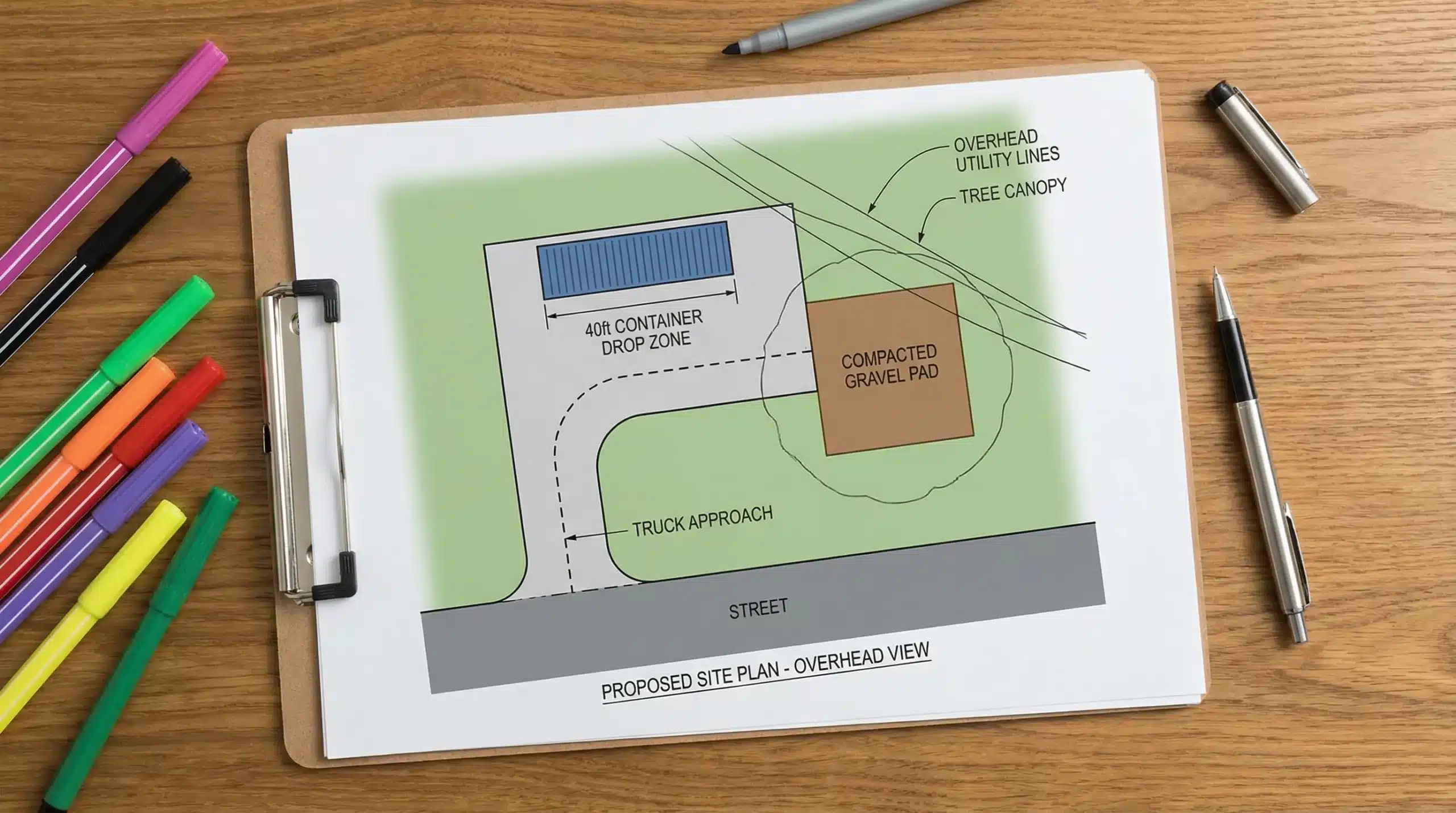
1) Walk the access route (street to final spot)
Check the full route the truck must travel, not just the final pad.
Look for:
- Gate and driveway width that allows the truck to maneuver
- Tight corners (a common failure point in residential neighborhoods)
- Soft shoulders, culverts, or steep transitions
- Street parking or low-hanging branches that block alignment
If you are in a dense area (parts of Miami, Atlanta, Phoenix, Dallas, or older neighborhoods with narrow streets), consider reserving curb space so the driver can line up.
2) Confirm overhead clearance (more than just the final placement area)
Overhead clearance issues often appear in unexpected places:
- Trees over the driveway
- Roof eaves and carports
- Low utility lines along the approach
If anything looks close, do not guess. Choose an alternate route or placement area, or arrange a different offload method.
3) Build a level, well-drained base
A container that is out of level can lead to:
- Doors that stick or do not seal smoothly
- Water pooling along edges
- Long-term frame twist
Common foundation options:
- Compacted gravel pad (popular for homes, farms, and jobsites, good drainage)
- Concrete pad (best for long-term placement and heavy daily use)
- Piers/footings (useful on sloped ground when properly planned)
If you are in wet regions (Gulf Coast, Southeast, Pacific Northwest) or areas with heavy seasonal rain, prioritize drainage so water does not sit under the container.
4) Plan support points (do not rely on soft soil)
Shipping containers are designed to carry loads at the corners. For storage use, many buyers support at the corners, and may add support points depending on ground conditions and use.
If your site is:
- Muddy
- Uneven
- Recently graded
- Prone to pooling water
Upgrade the base before delivery. Fixing the foundation after a 40ft high cube is down can require equipment and extra cost.
5) Decide door orientation before the truck arrives
Door direction is easy to overlook and annoying to correct later.
Confirm:
- Do doors face your driveway for easy loading?
- Do you want doors away from wind-driven rain?
- Are you planning future modifications that depend on orientation?
6) Mark the drop zone and clear the work area
Before delivery:
- Remove debris, equipment, and low branches
- Keep pets and children safely indoors
- Mark the exact placement location (stakes or paint)
Quick printable site prep table
| Item to prep | Target outcome | What can go wrong if skipped |
|---|---|---|
| Access route | Clear, drivable path from street | Driver cannot reach the drop zone |
| Turning space | Enough room to align safely | Failed placement, re-delivery fees |
| Overhead clearance | No contact risk during offload | Dangerous situation, canceled drop |
| Firm ground | Stable surface for heavy truck | Ruts, cracked asphalt, stuck vehicle |
| Level base | Container sits level end-to-end | Doors bind, water pooling, premature wear |
| Placement plan | Marked location and door direction | Container lands in the wrong spot |
Delivery day: what to expect and what to inspect
A professional delivery typically moves quickly once the driver arrives. The best outcomes happen when an informed buyer is onsite to confirm placement.
Typical delivery flow
- The driver checks access and confirms the set location.
- The container is positioned and offloaded.
- You do a quick inspection and confirm doors operate.
(Exact steps vary by tilt-bed, flatbed, or crane.)
10-minute inspection checklist (focus on what matters)
Cosmetic wear is normal on used units. Focus on function, security, and weather protection.
| Inspection item | What to check | Why it matters |
|---|---|---|
| Doors and locking bars | Open/close fully, handles and cams work | A container you cannot open easily is a daily problem |
| Door seals | No obvious gaps when closed | Helps prevent water intrusion |
| Light test | Close doors and look for daylight | Pinholes can exist on used units, bigger gaps should be flagged |
| Roof and top rails | Major dents or low spots | Dents can hold water and accelerate corrosion |
| Floor condition | Soft spots, delamination, strong odors | Floor repairs are expensive and disruptive |
| Corner posts and frame | Obvious twist or major impact damage | Structural issues affect usability and placement |

If anything looks off, document it immediately (photos and notes) and contact your supplier right away.
Common 40ft high cube delivery mistakes (and how to avoid them)
Mistake: Underestimating height. A high cube is taller than standard. Confirm overhead clearance along the entire route.
Mistake: Assuming any driveway can handle the truck. Heavy trucks can damage soft asphalt, pavers, or wet ground. Prepare a stable approach or choose an alternate drop zone.
Mistake: Ignoring drainage. Standing water under the container increases corrosion risk and creates muddy access at the doors.
Mistake: Deciding placement at the last minute. Mark the drop location and door direction ahead of time.
When a 20ft container might be the better choice
If your property has tight access, steep grades, or limited space, a 20ft unit can be easier to place while still providing serious storage.
You can compare inventory here: 20ft shipping containers.
Frequently Asked Questions
How much does it cost to buy a 40ft high cube container delivered? Pricing depends on condition (new vs used), inventory near your region, delivery distance, offload method, and site access. The most accurate approach is to request a delivered quote for your ZIP code.
How fast can Global Containers Line deliver a 40ft high cube container in the USA? Timing depends on inventory positioning and scheduling, but we offer fast nationwide delivery across the United States, including major markets like Houston, Dallas, Atlanta, Phoenix, Miami, and many more.
What condition are your 40ft high cube containers in? We supply new and used units. All containers are cargo-worthy, wind and watertight, and thoroughly inspected before dispatch.
Do I need a permit to place a 40ft high cube container on my property? Sometimes. Rules vary by city, county, and HOA. Check local zoning, setbacks, and any time limits for “temporary” storage containers, especially if the container will be visible or used commercially.
What is the best base for a 40ft high cube container? A level, compacted gravel pad is a common, cost-effective choice for storage. For permanent installs or heavy daily use, a concrete pad can be ideal. Your best option depends on soil conditions, drainage, and how you plan to use the container.
What should I do if the driver cannot place the container where I want it? Stop and reassess before offload. A safe alternate placement spot is better than forcing a risky set. This is also why it is important to confirm site access and placement details in advance.
Get a delivered quote for a 40ft high cube container (and avoid re-delivery surprises)
If you are ready to buy a 40ft high cube container, Global Containers Line makes it straightforward with secure online ordering, transparent pricing, inspected inventory, and fast nationwide delivery across the USA.
Browse available options or request a delivered quote:
- Shop 40ft shipping containers
- Compare sizing with 20ft shipping containers
Share your delivery ZIP code and any access constraints (tight turns, slope, overhead lines). We will help you plan a smooth delivery and placement from day one.