
Buying a cheap 20ft shipping container for sale can be a smart move for storage, job sites, farms, and small businesses. The problem is that “cheap” is also the word scammers and low-quality resellers hide behind.
A 20ft container is a big, heavy steel asset that has to be transported by truck, and delivered safely to your property. If the price looks unusually low, it often means something is missing (delivery, condition guarantees, paperwork) or something is wrong (damage, leaks, title issues, or a seller who does not actually have the unit).
Below are the most common red flags U.S. buyers should watch for, plus what to ask so you can still get a great deal without buying a headache.
What “cheap” should mean (and what it should not)
A “cheap” container should mean good value for your use case, usually by choosing the right condition level (used vs one-trip), being flexible on color/appearance, or buying at the right time of year.
It should not mean:
- No clear container condition (or “you get what you get”)
- No recent photos
- No delivered price
- Pressure to pay fast with risky payment methods
- A container that is not wind and watertight when you need secure storage
If you’re comparing sellers across the U.S. (for example Texas, Florida, Georgia, Arizona, California, or the Midwest), remember that location affects price. A container in Houston or Miami may price differently than one delivered inland to Dallas, Phoenix, Atlanta, or rural areas because trucking and depot availability vary.
Red flags to know when shopping a cheap 20ft shipping container for sale
Use this section as a quick screening guide before you waste time on a “deal” that turns into a loss.
Red flag 1: The price is far below the local market (and the seller won’t explain why)
Real discounts happen, but extreme underpricing is usually tied to:
- “As-is” condition (often not wind and watertight)
- Major floor damage
- Rust-through holes or patched panels
- Missing lockboxes or damaged doors
- No delivery included
What to do: Ask for the delivered price to your ZIP code, the condition grade, and recent photos (including door seals and roof).
Red flag 2: You cannot get a delivered quote (only a pickup price)
Many “cheap” ads are yard pricing only. If you need delivery, your total cost can jump once trucking, fuel, and offload method are added.
What to do: Confirm whether the quote includes:
- Delivery to your address
- Offloading method (tilt-bed, roll-off, crane)
- Any access or distance fees
If a seller refuses to quote delivery, you may end up coordinating trucking yourself (more risk, more moving parts, more cost).
Red flag 3: “Cargo-worthy” is claimed, but there’s no proof
For containers used in transport and export, “cargo-worthy” is often associated with having a valid CSC safety approval plate and being structurally sound for service.
What to do: Request a photo of the CSC plate and the container ID/serial. For background on the CSC standard, see the International Maritime Organization (IMO) overview of the CSC.
Red flag 4: No recent photos (or the photos look like stock images)
A common tactic is posting a clean photo of a new container while delivering an unrelated used unit.
What to do: Ask for time-stamped or clearly recent photos of:
- Both sides
- Roof (important for leaks)
- Door gaskets and locking bars
- Floor close-ups (especially near the doors)
If they will not provide them, that is your answer.
Red flag 5: The seller won’t state the condition in plain English
Industry terms vary, but a legitimate seller should still be able to explain condition simply.
Be cautious if you hear only vague lines like “good shape for its age” without specifics about:
- Wind and watertight performance
- Floor integrity
- Door operation
- Rust levels (surface rust vs rust-through)
What to do: Ask, “Is it guaranteed wind and watertight?” and “Do the doors open and close smoothly?” If they dodge, move on.
Red flag 6: Payment pressure, wire-only, crypto-only, or “friend and family” requests
High-pressure tactics are a classic scam signal, especially with untraceable payments.
What to do: Choose sellers that offer secure checkout and clear invoices. For general guidance on recognizing and avoiding payment scams, review the FTC scam advice.
Red flag 7: No real business footprint (no address, no yard, no phone support)
Some listings are middlemen who do not control inventory. Others are outright fake.
What to do: Verify:
- Business name and website
- A real phone number
- A physical yard location (or a clear explanation of where inventory is staged)
Red flag 8: Delivery details are unclear (or “delivery anytime” sounds too easy)
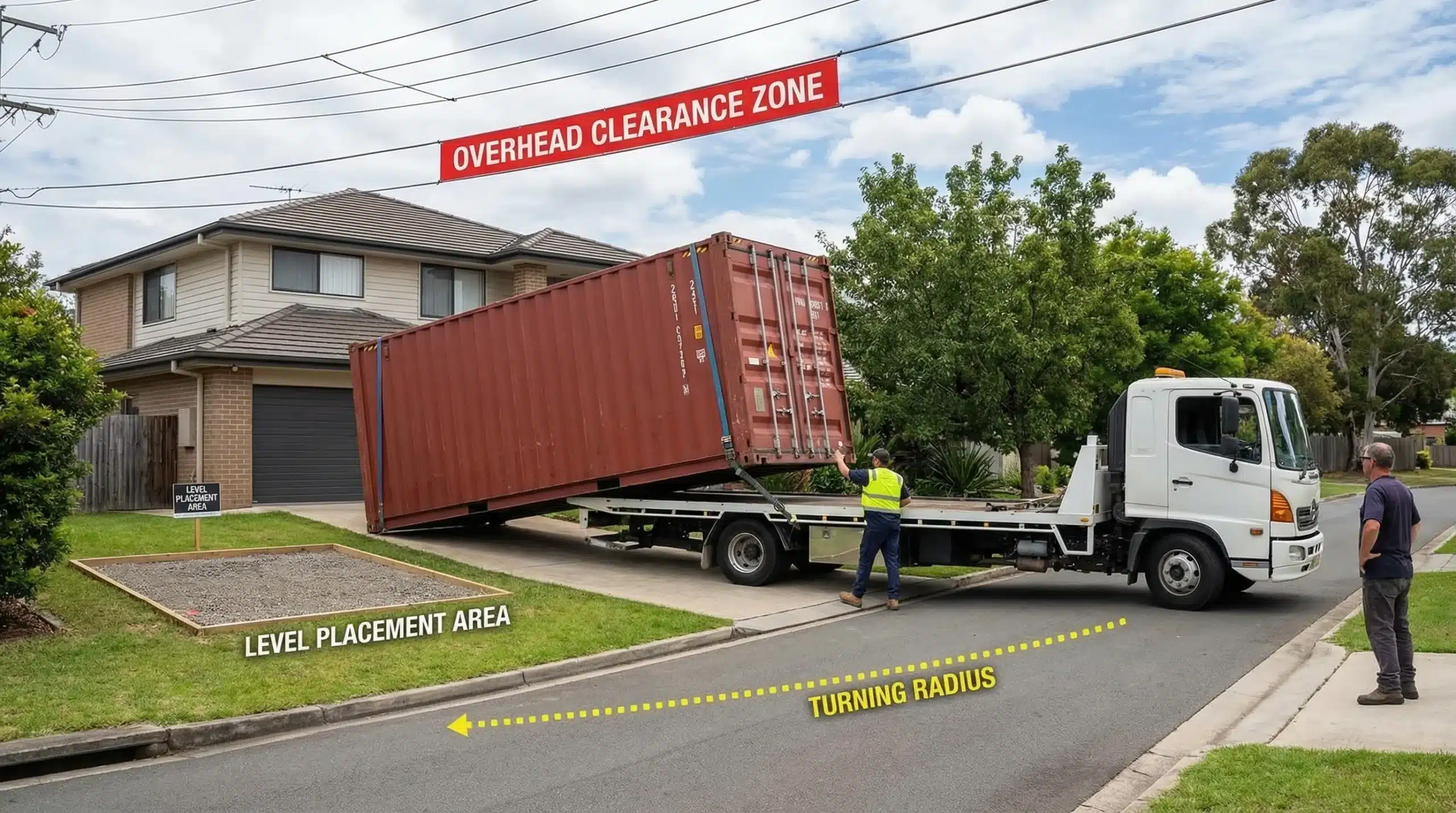
A 20ft container delivery requires planning. If a seller says they can drop it “anywhere” with no questions, they might be outsourcing delivery last-minute.
What to do: Confirm:
- Truck type
- Turning radius needs
- Overhead clearance requirements
- Where doors will face after placement
This is especially important in tighter areas (parts of Los Angeles, Miami neighborhoods, dense Atlanta suburbs) and on active construction sites.
Red flag 9: The floor is not discussed (even though it is a high-cost problem)
Container floors matter for storage and safety. Bad signs include soft spots, delamination, heavy oil saturation, or signs of chemical damage.
What to do: Request floor photos and ask whether the floor is solid throughout.
Red flag 10: “One-trip” is claimed, but the unit looks heavily used
One-trip containers are typically newer and cleaner than used units. If it has major dents, extensive corrosion, or hard-to-operate doors, question the label.
What to do: Ask what “one-trip” means in their listing, and request confirmation of condition and photos.
Quick comparison table: red flags and the safest next question
| Red flag you see | Why it matters | Safest next question to ask |
|---|---|---|
| Price is unusually low | Often hides condition or delivery costs | “What’s the delivered price to my ZIP code, all-in?” |
| No recent photos | You may not get the container shown | “Can you send current photos of roof, doors, floor, and both sides?” |
| Vague condition claims | Storage performance is unknown | “Is it guaranteed wind and watertight?” |
| Cargo-worthy claim without proof | Transport compliance may be questionable | “Can you provide a photo of the CSC plate and container ID?” |
| Wire-only or pressure to pay | Higher scam risk | “Do you offer secure checkout and an invoice with company details?” |
| Delivery is hand-waved | You risk a failed delivery or extra fees | “What truck/offload method will be used, and what clearances do I need?” |
Pricing questions buyers should ask (without getting misled)
If you’re searching “cheap 20ft shipping container for sale,” you’re likely trying to keep costs controlled. The key is to compare apples to apples.
Ask for a delivered price, not just a container price
A fair quote should clearly separate:
- Container cost
- Delivery cost
- Any additional fees (access constraints, waiting time, etc.)
If a seller cannot give you a delivered quote after you provide your ZIP code and basic site info, that is a sign the “cheap” number is just an attention grab.
Know what drives 20ft container pricing in the U.S.
Prices vary by:
- Condition (used vs one-trip)
- Local supply near ports and depots
- Steel market changes
- Delivery distance to your location
- Seasonality (construction season often increases demand)
If you want deeper guidance on timing, see our related post: 20ft shipping container for sale: best time to buy in 2026.
Delivery red flags (and how to avoid a failed drop)
A “cheap” purchase can become expensive if delivery fails and you get charged a re-delivery fee.
Site basics you should confirm before booking
- Clear path for a delivery truck
- Level, stable ground where the container will sit
- Overhead clearance (trees, power lines, building eaves)
- Enough space to place the container with the doors facing the direction you want
If you’re in a tight urban area, delivery planning matters even more. This is why many buyers prefer working with a supplier that can coordinate delivery nationwide instead of leaving logistics to you.
Condition questions that protect you from “cheap but unusable” containers
Not every buyer needs the same grade. The mistake is buying the wrong condition because it was the lowest price.
For storage: prioritize wind and watertight
If you’re storing tools, furniture, inventory, farm supplies, or equipment, wind and watertight should be the minimum. Leaks and door seal problems are where “cheap” turns into damaged goods.
For export or transport: confirm cargo-worthy details
If you need the container for shipping freight, you should verify cargo-worthy condition and documentation expectations. Ask for the container ID, plate details, and photos of the structural points (corner castings, doors, roofline).
For conversions: don’t buy the cheapest unit unless you understand the trade-offs
If you’re modifying the container (office, kiosk, workshop, or a building project), deep dents, heavy corrosion, and twisted frames can raise your fabrication and labor costs.
For general online buying due diligence, you can also reference: Buy shipping containers online with confidence.
Buy with confidence from a trusted U.S. supplier (and still keep it affordable)
Global Containers Line supplies new and used 20ft, 40ft, and high cube shipping containers for storage, construction, commercial, and residential use. Our containers are cargo-worthy, wind and watertight, and thoroughly inspected before dispatch. We also provide fast nationwide delivery across the United States, including major markets like Houston, Dallas, Atlanta, Phoenix, and Miami.
If you’re trying to find a cheap 20ft shipping container for sale, the safest way to do it is to get a transparent delivered quote and pick the condition that matches your needs.
Browse inventory or request a delivered quote
- Browse 20ft shipping containers for secure storage and job site use.
- Need more space? Compare 40ft shipping containers for higher-capacity storage and projects.
If you’re not sure what condition or delivery setup fits your site, request a quote and we’ll help you confirm pricing, delivery access, and the right container for your location in the USA.