
A flat pack shipping container for sale can look like the perfect shortcut: lower freight cost, easier access to tight sites, and a “container-style” space you can assemble yourself. But it is not the same thing as a traditional ISO shipping container, and whether it is “worth it” depends on what you need the container to do.
If you want durable, secure storage delivered fast across the U.S., a standard 20ft or 40ft steel container is often the better long-term value. If you need a kit you can carry through a gate, build on a rooftop, or ship as palletized freight, flat pack can make sense.
What is a flat pack shipping container?
A flat pack “shipping container” is typically a panelized container-style kit that ships knocked down (flat) on pallets. It is assembled on-site using wall panels, a roof panel, a floor system, and doors.
Two important clarifiers:
- Most flat pack units are not ISO freight containers designed for ocean transport and stacking in a global intermodal system.
- Many are designed for storage and shelter, not for repeated lifting by corner castings or international shipping under the Container Safety Convention (CSC).
That does not make flat pack “bad.” It just means you should evaluate it like a modular storage building rather than assuming it performs like a cargo container.
Flat pack vs standard shipping container: the differences that matter
If your goal is to compare options quickly, this table covers the real-world tradeoffs buyers run into in the USA.
| Feature | Flat pack container (kit) | Standard ISO shipping container (20ft/40ft) |
|---|---|---|
| How it ships | Palletized freight (often LTL/flatbed) | Delivered as a complete unit on a container truck |
| On-site time | Requires assembly and squaring | Typically ready to use the day it arrives |
| Structural strength | Varies by manufacturer and design | Built for heavy-duty transport and stacking |
| Security | Depends on door hardware and wall design | Heavy steel doors, lockboxes available |
| Weather resistance | Varies, must confirm sealing details | Common grades include wind and watertight |
| Mobility | Can be disassembled and moved (sometimes) | Can be relocated by tilt-bed/crane and chassis |
| Best use cases | Tight access sites, temporary storage, DIY projects | Long-term storage, job sites, export, conversions |
| Resale value | Typically lower and more brand-dependent | Mature resale market and standardized sizes |
If you need a unit that is cargo-worthy for transport and rugged handling, you are usually in standard container territory.
When a flat pack shipping container is worth it
Flat pack kits can be the right call in several common situations.
You have access limitations
If a full-size delivery truck cannot reach your site, a flat pack can be delivered as pallets and moved in smaller pieces.
Common examples in the U.S.:
- Urban backyards with narrow side access (parts of Los Angeles, San Diego, Seattle)
- Gated properties and HOAs with delivery restrictions (parts of Florida and Arizona)
- Job sites with tight staging areas in dense metros (New York City boroughs, Chicago)
You want a “build it where it sits” workflow
If you are placing the unit on a rooftop, inside a warehouse, or behind an existing structure, a flat pack can be assembled exactly where it will be used.
You need palletized freight logistics
Flat pack units may ship via LTL freight, which can be easier to schedule than specialized container delivery in certain rural routes.
That said, always compare delivered pricing, not just the kit price, because access savings can be offset by assembly cost.
Your use is temporary and light-duty
For temporary storage of light tools, seasonal items, or short-term site materials, a flat pack can do the job if it is properly sealed and anchored.
When a standard container is the smarter buy
If any of the points below describe your project, a traditional container is usually the better “worth it” decision.
You need true container durability and security
Standard steel ISO containers are built for hard use. For contractors storing expensive equipment overnight, or small businesses protecting inventory, the security and robustness of a traditional unit are difficult to replicate.
You want fast setup with fewer variables
With a standard container, there is no assembly step. Once your site is ready, delivery is often the only major milestone.
Global Containers Line supplies new and used shipping containers that are cargo-worthy, wind and watertight, and thoroughly inspected before dispatch, with fast nationwide delivery across the United States.
If you are comparing sizes, these are the two most common starting points:
- Browse a 20ft shipping container if you want the best balance of footprint and capacity.
- Choose a 40ft shipping container when you need maximum storage volume for the delivery cost.
You may resell later
Standard container sizes (20ft and 40ft, including high cube options) are widely recognized and easier to price and resell because buyers understand the format.
You need cargo-worthy or export-friendly options
If your project involves transport, export, or regulated requirements, you should understand CSC compliance. The International Maritime Organization (IMO) provides background on the CSC framework used in global container transport standards (learn more via the IMO). Many flat pack kits are not built for this role.
Flat pack shipping container pricing: what you are really paying for
Buyers often ask: “Is a flat pack shipping container cheaper?” Sometimes yes upfront, but the total cost depends on what you must add.
Typical cost components to compare
| Cost item | Flat pack container | Standard container |
|---|---|---|
| Unit price | Often lower advertised price | Varies by size and condition (new vs used) |
| Freight to your location | Often pallet freight, may be cheaper | Container delivery using specialized equipment |
| Assembly labor | Often required unless DIY | None |
| Tools and consumables | Fasteners, sealants, lift equipment | Typically none |
| Site base/foundation | Often required for squareness and sealing | Strongly recommended, but container can be set on supports |
| Weatherproofing | Verify seals, roof design, penetrations | Wind and watertight options commonly available |
| Security upgrades | May be needed | Lockboxes and high-security options common |
The “worth it” rule of thumb
A flat pack is more likely to be worth it when:
- You truly cannot accept a full container delivery truck on-site, or
- You have a reliable, low-cost way to assemble (in-house crew, proper tools), and
- Your use case is storage or shelter, not heavy transport or high-security storage.
If you will pay a crew to assemble, rent lifting equipment, and spend time troubleshooting sealing and alignment, a standard container often wins on total value.
Delivery: flat pack freight vs container delivery in the USA
Delivery is one of the biggest differences, and it is where many “cheap” listings become expensive.
How flat pack delivery usually works
Flat pack units often arrive as palletized loads. You typically need:
- A forklift, skid steer, or pallet jack plan (depending on pallet weight and surface)
- A clear staging area to lay out panels
- A realistic weather window (assembly in rain or high winds slows everything)
How standard container delivery usually works
A traditional container is commonly delivered by:
- Tilt-bed (roll-off) delivery for many residential and job site drops
- Flatbed with a crane or forklift offload if required
Either way, you need to plan for:
- Overhead clearance (trees, power lines)
- Turning radius and driveway strength
- Door orientation at drop
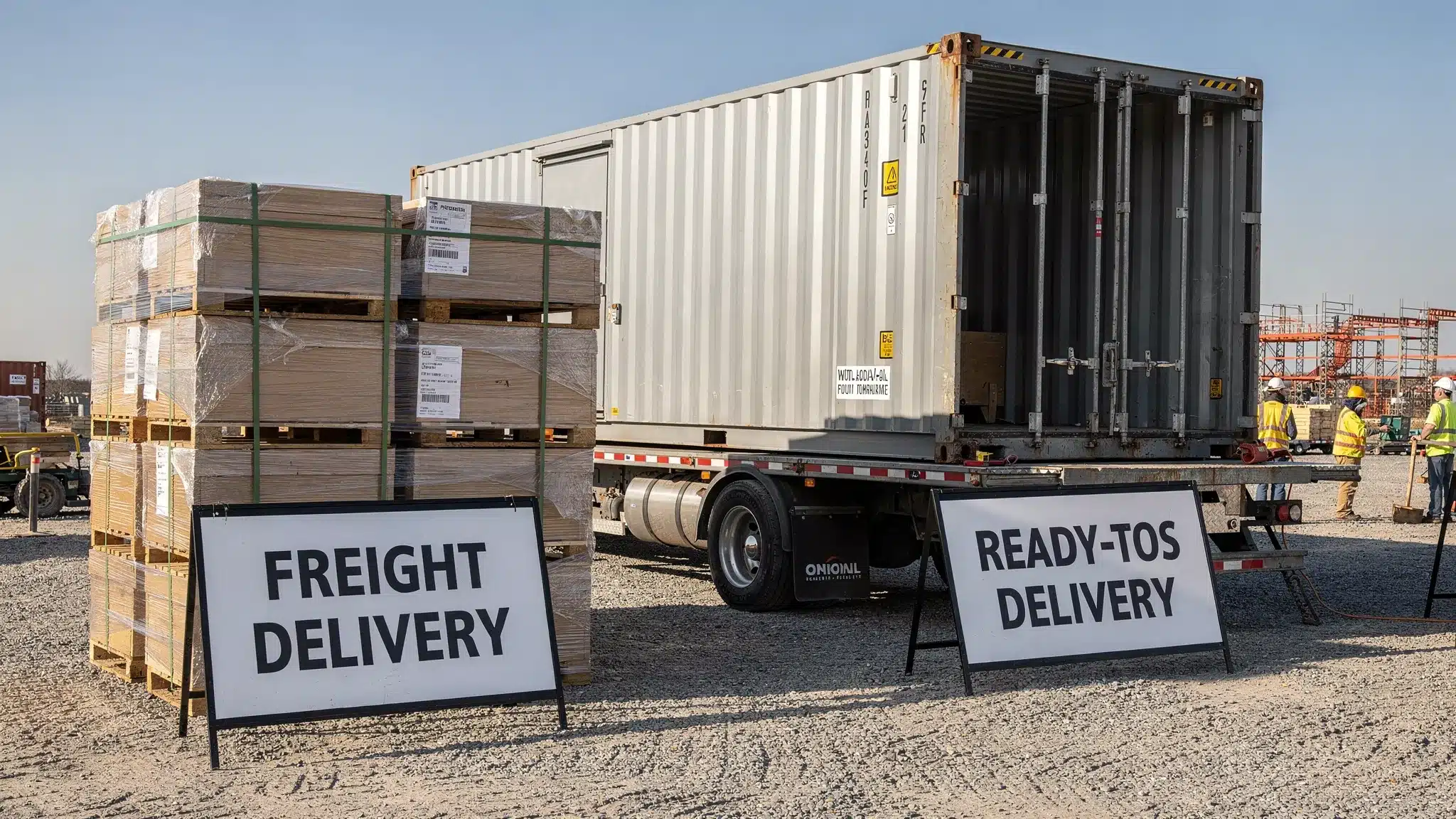
Global Containers Line supports buyers with fast nationwide delivery across the United States, including major markets like Houston, Dallas, Atlanta, Phoenix, Miami, Los Angeles, and many more locations nationwide.
For a broader walkthrough of what to expect after you order, you can also reference the company’s shipping container buying guide.
Container condition and quality: what to ask before you buy
Because “flat pack shipping container” can mean many different designs, condition questions are different than for traditional containers.
For flat pack containers
Ask the seller:
- What is the wall and roof material thickness?
- How are corners reinforced?
- What seals are used around doors and roof joints?
- Is there a rated wind load or snow load?
- Is the floor steel-framed, plywood, or another system?
Also ask for real photos of the exact model and details of warranty terms.
For standard shipping containers (new or used)
The key condition terms buyers should understand:
- Cargo-worthy: suitable for transport, typically structurally sound with functional doors.
- Wind and watertight: resists wind-driven rain, no active leaks.
- One-trip (new): minimal wear, often best for conversions.
Global Containers Line states its containers are cargo-worthy, wind and watertight, and inspected before dispatch, which is exactly what most buyers want when the goal is reliable storage with fewer surprises.
Quick checklist: before you buy a flat pack shipping container for sale
Use this quick list to avoid the most common buying mistakes.
- Confirm your intended use (temporary storage vs long-term secure storage vs transport).
- Compare delivered cost, including assembly labor and equipment rental.
- Ask how long assembly takes and what tools are required.
- Verify weather sealing details (roof joints and door frame are common leak points).
- Confirm anchoring recommendations for your region (wind exposure matters in places like Texas and coastal Florida).
- Check local rules (permits, HOA requirements, setback rules).
- If storing valuables, plan security upgrades and consider insurance coverage.
If you are also managing insurance decisions as part of a broader move or property plan, some buyers prefer online comparison tools. For example, UAE residents can compare insurance online to shop car, home, health, or life coverage efficiently.
Frequently Asked Questions
Is a flat pack shipping container the same as a real shipping container? No. Flat pack units are typically panelized kits for storage or shelter. Standard ISO shipping containers are built for intermodal transport and heavy handling.
How long does a flat pack container take to assemble? It depends on the kit design, site base, and crew experience. Plan for at least several hours to a full day for many projects, plus time to level the base and seal joints.
Are flat pack containers wind and watertight? Some can be, but it is not automatic. Ask exactly how the roof and wall joints are sealed and whether the seller provides performance ratings or warranty terms.
What is the cheapest way to get a container delivered in the USA? The cheapest option depends on distance, access, and equipment. Flat pack freight can reduce shipping cost, but standard containers often reduce total cost by eliminating assembly and rework.
Do I need a permit for a flat pack or standard container? Rules vary by city and county. Some areas treat containers as accessory structures, especially for long-term placement. Always check local zoning, HOA rules, and setback requirements.
Can I move a flat pack container later? Sometimes. Many are designed to be disassembled, but repeated moves can stress panels and seals. Standard containers are typically easier to relocate with the right truck and access.
What size should I buy, 20ft or 40ft? A 20ft is easier to place and fits many residential and job site uses. A 40ft offers the best cost per square foot when you have room for delivery and placement.
Does Global Containers Line sell flat pack shipping containers? Global Containers Line focuses on new and used ISO shipping containers (including 10ft, 20ft, 40ft, and high cube options). If you are deciding between flat pack and traditional containers, the team can help you choose the best fit for your site and timeline.
Browse available containers or request a delivered quote
If you are on the fence, here is the simplest way to decide: if you want ready-to-use, secure storage with proven durability, choose a standard container.
Global Containers Line is a trusted U.S. supplier with transparent pricing, secure online ordering, inspected containers, and fast nationwide delivery across the United States.
Browse inventory and get started:
If you want help comparing delivered cost for your city or job site (Houston, Dallas, Atlanta, Phoenix, Miami, or anywhere in the U.S.), request a quote and share your zip code, access notes, and preferred size.