
Buying shipping containers in 2026 is less about “just get a 20ft” and more about matching type + grade + intended use + delivery realities. The right combination can mean years of dry, secure storage, a truly cargo-worthy unit for shipping, or a clean foundation for a container-based build. The wrong choice can mean persistent leaks, sticking doors, surprise repairs, or a container that fails inspection requirements.
Explore our available shipping containers for sale in the USA with fast nationwide delivery and transparent pricing.
This updated guide explains the most common shipping container types, how container grades are typically described in the U.S. market, and how to choose based on your jobsite, business, or project goals. It is written to support both informational research and buyers ready to compare options and request pricing.
Buy New & Used Shipping Containers Across the USA – Fast Nationwide Delivery
Ready to price a unit or confirm availability? Global Containers Line helps customers source new and used shipping containers for sale in USA with reliable logistics and clear guidance.
✔ Nationwide delivery across the USA
✔ Transparent pricing with clear condition explanations
✔ Inspected & cargo-worthy units available
✔ Phone: +1 (656) 250-7440
✔ Email: sales@globalcontainerslineltd.com
Table of contents
Shipping container sizes buyers actually compare: 20ft vs 40ft (and high cube)
Shipping container types in 2026 (and the best uses for each)
Shipping container grades and conditions (definitions you can quote)
Comparison table: container types and grades (quick decision helper)
How to choose the right container for your use (commercial buyer guidance)
Shipping container prices in 2026: what drives cost in the USA
Shipping containers for sale near you in the USA (local demand & logistics)
What’s different about shipping containers in 2026?
A few real-world trends are shaping how buyers compare new vs used shipping container options and how sellers are expected to document condition.
More non-shipping use cases: jobsite storage, retail pop-ups, farms, workshops, and container-based builds keep demand strong beyond freight.
Higher expectations for condition transparency: buyers want straightforward terms like cargo-worthy vs wind and watertight, plus photos and inspection notes.
Delivery constraints matter more than ever: residential and urban deliveries require planning for turn radius, overhead lines, and stable placement.
More permitting and compliance questions: especially for container-based buildings, local code and zoning rules can influence which type and grade makes sense.
The practical takeaway: define your end use first, then pick size + type + grade that fits it, and validate delivery access before you pay.
Shipping container sizes buyers actually compare: 20ft vs 40ft (and high cube)
Most buyers narrow down options by size first, then by grade. If you already know the size you want, you can jump straight to inventory pages:
Browse a 20ft shipping container for sale for versatile storage and jobsites.
Compare options for a 40ft shipping container for sale when you need maximum space and value per square foot.
20ft shipping containers
A 20ft is often the easiest “fits most places” choice. It typically offers a strong balance of capacity and delivery flexibility, especially for:
Construction tools and materials
Retail backstock
Farm equipment storage
Small business inventory
40ft shipping containers
A 40ft is often the best cost per square foot, but it demands more delivery room and a better pad. It is popular for:
Larger inventory storage
Equipment and parts warehousing
Multi-zone organization (racking, workbench, parts bins)
High cube containers (extra height)
40ft high cube container for sale
High cube units are taller (commonly 9ft 6in exterior height instead of 8ft 6in). They are frequently chosen for:
Racking systems
Taller equipment
Workshops and conversions where headroom matters
Shipping container types in 2026 (and the best uses for each)
Most people start with a standard “dry” container, but specialty types can prevent expensive compromises when your access needs, cargo type, or project design is specific.

New & used 16ft shipping containers for sale
30ft shipping containers available for delivery
45ft high cube shipping containers for sale
Standard dry container (DV)
The everyday workhorse for storage and shipping. Fully enclosed, lockable, and widely available.
Best for: general storage, most domestic and intermodal shipping.
High cube (HC)
A dry container with extra height. Popular for storage where vertical clearance matters and for build-outs.
Best for: tall storage, racking, workshops, conversions.
Double door (tunnel)
Doors on both ends for easier loading, ventilation, and access.
Best for: inventory operations where you want “flow-through” loading and unloading.
Side-opening container
Full-length side doors (or partial side access). Often easier for pallet access by forklift.
Best for: warehouse-style loading, workshops, retail displays.
Refrigerated container (reefer)
Insulated container with refrigeration machinery.
Best for: cold storage for food, beverages, pharmaceuticals, floral operations.
Insulated container (non-operating reefer shell)
An insulated shell without active cooling (varies by seller).
Best for: temperature buffering, retrofits, specialty storage.
Open-top container
Open roof (typically covered with tarp and bows) for top-loading oversized cargo.
Best for: machinery and awkward cargo loaded by crane.
Flat rack
Cargo platform with end walls (sometimes collapsible).
Best for: oversized and heavy cargo that cannot fit in an enclosed container.
Shipping container grades and conditions (definitions you can quote)
Grade language is not perfectly standardized across every seller, so you should ask what inspection process supports the label. Still, most U.S. listings use a common set of terms.
To improve clarity (and help you compare quotes), here are buyer-friendly definitions.
New / one-trip: A container that typically made one loaded trip from the factory to its destination. Usually the cleanest option with minimal wear.
Cargo-worthy (CW): Generally indicates the container is suitable for transport and can pass an industry cargo-worthy inspection. A common baseline when you intend to ship.
Wind & watertight (WWT): Generally indicates the container keeps out wind and water under normal conditions (no holes in the roof, doors seal). Often ideal for storage.
As-is: Sold in current condition with limited assurances. Often lower cost, often requires repairs.
New (often called “one-trip”)
New containers are typically the best choice when appearance matters or when you want the cleanest starting point for a long-term project.
Best for: visible placements (retail, events), premium storage, conversions.
Used containers (various conditions)
Used containers range from “still great” to “rough but functional.” The key is aligning cosmetic tolerance and repair willingness to your application.
Best for: budget-focused storage, jobsites, industrial use.
CSC plate note (if you plan to ship)
If you plan to use a container in ocean freight or formal intermodal shipping, you may need a valid CSC Safety Approval Plate under the IMO Convention for Safe Containers (CSC). Carriers and depots can have additional requirements, so always verify before purchase.
Comparison table: container types and grades (quick decision helper)
Use this table as a fast filter when you are comparing “what should I buy” options.
| What you need | Recommended size/type | Typical grade to target | Why it works |
|---|---|---|---|
| Secure storage for tools or inventory | Standard dry (20ft or 40ft) | Wind & watertight | Prioritizes a dry interior and working doors at a practical price |
| Export or formal freight moves | Standard dry (match cargo) | Cargo-worthy | Aligns with common inspection expectations for transport |
| Workshop or retail conversion | High cube or side-opening | New (one-trip) or top-quality used | Reduces prep work, improves finish quality |
| Tight placement area | 20ft standard or 20ft HC | WWT or new | Easier delivery and positioning |
| Cold storage | Reefer | Depends on operating condition | Refrigeration performance and service history drive value |
| Oversized equipment loading | Open-top or flat rack | Cargo-worthy (as needed) | Designed for top loading or out-of-gauge cargo |
How to choose the right container for your use (commercial buyer guidance)
If you are trying to “buy once, cry once,” focus on how the container will be used day to day, not just the lowest quote.
Request a shipping container quote in your state
If you need storage (most buyers)
A storage buyer usually wants: dry interior, secure doors, acceptable floor condition, and predictable delivery.
Practical recommendation:
Choose 20ft when access is tight or you want simpler placement.
Choose 40ft when you want the best cost per square foot and have a clear approach path.
Choose WWT when cosmetics do not matter but dryness does.
Choose new / one-trip when this will sit in a visible location or you want minimal maintenance.
If you are building a storage yard or recurring rental/storage operation, also look at container storage units for sale to match units to customer demand.
If you need to ship freight
If you intend to ship, do not assume a “storage grade” container is acceptable.
Practical recommendation:
Target cargo-worthy (CW) and confirm documentation expectations.
Inspect (or request inspection documentation) for door seal integrity, roof condition, and structural straightness.
Confirm whether you need a valid CSC plate and whether your carrier has additional requirements.
If you need a container for a build-out or conversion
Conversions punish bad doors, twisted frames, and heavy rust. A higher-quality unit is often cheaper overall once you price the labor to fix issues.
Practical recommendation:
Choose high cube for interior comfort and flexibility.
Start with new / one-trip (or carefully selected used) to reduce surface prep, repairs, and surprises.
Plan code and permitting early. A container being watertight does not make it compliant for occupancy.
Shipping container prices in 2026: what drives cost in the USA
Check current shipping container prices near you.
Buyers often ask for “average container prices in the USA,” but pricing moves with location, availability, and delivery constraints. Instead of relying on a national average, it is smarter to understand the inputs that change your quote.
Key price factors in 2026
Size: 40ft usually costs more overall, often less per square foot.
Condition/grade: new and cargo-worthy typically price higher than WWT and as-is.
Type: reefers, side-openers, and specialty units typically cost more than standard dry containers.
Local market supply: pricing can shift near major ports, rail hubs, and high-demand metro areas.
Delivery distance and complexity: tight residential access, long mileage, or special placement can increase delivery cost.
Seasonality and inventory cycles: availability and pricing can change throughout the year.
New vs used shipping container: cost trade-offs
A used unit can be the best value when appearance is not critical and you can tolerate dents and surface rust. A new unit can be the best value when:
The container will be customer-facing (retail, events, branded placements)
You want minimal prep work
You want a longer “clean life” before repainting or repairs
If you are comparing quotes, ask sellers to specify the grade in plain language (CW vs WWT vs as-is) and confirm what “inspection” means in their process.
Delivery & site preparation checklist (avoid failed drops)
Delivery is where many container purchases go sideways. A perfect unit can still become a problem if the truck cannot safely access or place it.
Nationwide shipping container delivery across the USA
Use this pre-delivery checklist to reduce delays, re-delivery fees, and placement compromises.
Access checklist
Confirm gate width and any narrow points
Measure turn radius for a delivery truck
Check overhead power lines, tree branches, and eaves
Identify soft ground risk (mud, sand, saturated soil)
Confirm the driver has adequate room to align for placement
Placement checklist
Prepare a level pad (compacted gravel is common for storage applications)
Plan for drainage (avoid low spots where water collects)
Leave door swing clearance and space to add a lockbox if desired
Decide final orientation (door direction, access side, security lighting)
Day-of-delivery checklist
Have a contact on-site with a clear phone number
Mark the placement location
Keep pets, vehicles, and people clear
Re-check overhead clearance at the exact drop point
If you are in the research phase and want location-specific availability, start with buy shipping containers near me and request a delivery-aware quote.
Shipping containers for sale near you in the USA (local demand & logistics)
Search volume keeps rising for “shipping containers for sale near me” because buyers want local availability and predictable delivery. In practice, containers move through major logistics corridors and high-demand states where construction, energy, import volumes, and warehousing drive consistent buying.
High-demand states and why they matter
Texas: major ports, energy sector, construction growth, and large jobsite storage needs
California: port activity, dense metro demand, and strong small-business storage market
Florida: hurricane preparedness storage, construction, and port-driven availability
Georgia: Southeast logistics growth and distribution networks
Illinois: central rail and warehousing demand
Arizona: construction growth and regional distribution
North Carolina: manufacturing and logistics expansion
City-level buying intent (common quote requests)
If you are comparing local pricing, delivery windows, and inventory, these pages help match your search to the right market:
How to evaluate a container before you buy (or at delivery)
Even if you buy online, you can reduce risk by knowing what to check and what to ask for.
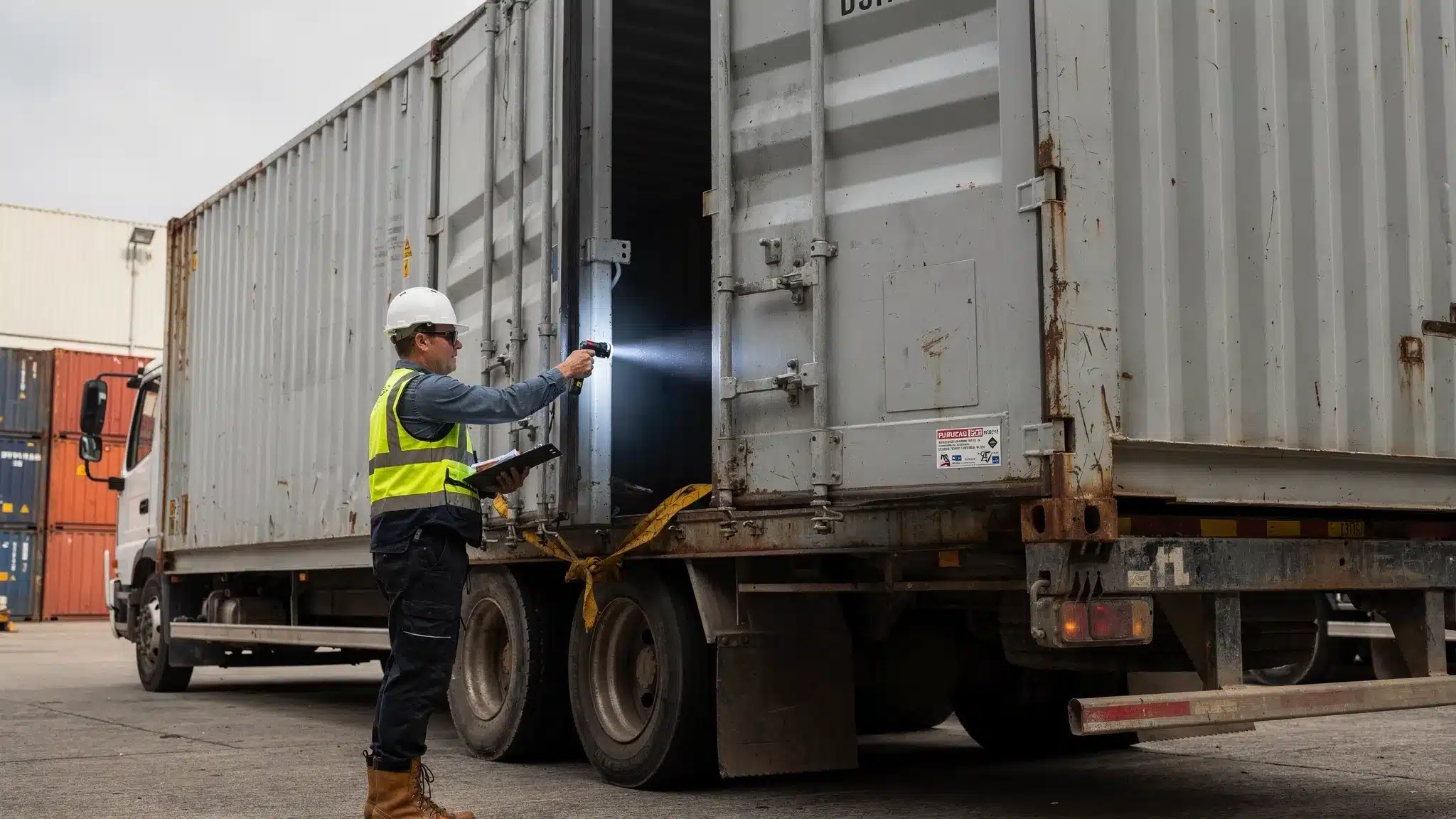
The big five inspection checks
1) Roof integrity: Roof holes are a top cause of “mystery leaks.” Small punctures can ruin stored goods.
2) Door operation and gasket seals: Doors should open and close without extreme force. Damaged gaskets and hard-to-close doors can signal frame twist.
3) Floor condition: Many container floors are wood-based. Look for soft spots, heavy staining, delamination, and odors that suggest contamination or moisture.
4) Corner castings and frame straightness: Structural deformation can matter for stacking, lifting, and build-outs.
5) Rust and past repairs: Surface rust is normal on used units. What you want to avoid is rust-through, heavy roof patchwork, and failing door gear.
A simple light test for leaks
On delivery, close the doors, stand inside briefly (with someone outside for safety), and look for points of light along seams and the roof. Light where it should not be can indicate gaps that may leak in rain.
Why Choose Global Containers Line (trust & E-E-A-T)
Buying a container is a high-value logistics purchase, not a casual online order. The seller’s inspection standards, communication, and delivery execution matter.
Why Choose Global Containers Line
Nationwide delivery across the USA
New & used inventory available
Competitive bulk pricing
Fast response time
Verified supplier network
Conclusion: choose the right shipping containers by matching use, grade, and delivery
Most buying mistakes happen when someone chooses a container based on size alone. Instead, match your end use to the correct type, then choose the grade that fits your tolerance for cosmetic wear and your need for shipping compliance. Finally, confirm delivery access and site prep so the unit can be placed safely where you need it.
If you want to keep the buying process simple, start with the size that fits your plan, then compare condition options and delivery requirements with a real quote.
Popular Container Sizes Available for Fast Delivery
refrigerated containers for temperature-sensitive storage
Frequently Asked Questions
How much does a shipping container cost in the USA? Container prices in the USA depend on size (20ft vs 40ft), condition (new vs used shipping container), container type (dry vs specialty), and delivery distance or complexity. The most accurate approach is to request a location-specific quote that includes delivery.
What size container do I need? A 20ft container is a common choice for jobsites and properties with tighter access. A 40ft container offers more space and often a lower cost per square foot but requires more room for delivery and placement. High cube units add height for racking, equipment, or conversions.
Can containers be delivered to residential locations? Yes, many shipping containers can be delivered to residential locations, but access and placement matter. Check gate width, turning room, overhead lines, ground stability, and the exact placement area before scheduling delivery.
Buy New & Used Shipping Containers Across the USA – Fast Nationwide Delivery
Global Containers Line makes it easy to source shipping containers with the right size, grade, and delivery plan.
✔ Transparent pricing
✔ Phone: +1 (656) 250-7440
✔ Email: sales@globalcontainerslineltd.com